[PR] This article contains affiliate links.
For luxury enthusiasts and fashion collectors traveling to Japan, one question dominates the itinerary planning process: Is Chanel actually cheaper in Japan?
The short answer for 2026 is a resounding yes—but the long answer is a fascinating, multi-layered journey into global currency economics, Japanese economic history, meticulously maintained secondary markets, and massive legislative changes to Japan’s tax-free shopping system.
Whether you are hunting for a brand-new pristine lambskin Classic Flap fresh out of the Ginza boutique or searching for a 1990s 24k gold-plated hardware vintage Diana Flap in the backstreets of Harajuku, Japan is arguably the greatest country on earth for buying Chanel. A combination of a historically weak yen, an unprecedented overabundance of luxury goods imported during Japan’s 1980s "Bubble Era," and the most strictly regulated anti-counterfeit secondhand market in the world makes Tokyo, Osaka, and Kyoto veritable treasure troves for the luxury shopper.
However, buying Chanel in Japan in 2026 requires strategy. Chanel global price harmonizations, rapid stock shortages, department store administrative fees, and a monumental overhaul of the Japanese tourist tax refund system implemented in late 2026 mean that you cannot just walk into a store blindly and expect a steal.
In this massive, exhaustive, 2026-updated guide, we will break down the exact mathematics of buying Chanel in Japan. We will compare 2026 retail prices in yen versus dollars and euros, explain the new airport tax refund procedures, decode the rigorous Japanese condition grading system, and provide an encyclopedic directory of the absolute best official boutiques and vintage stores in the country—complete with exact prices, opening hours, and precise transit directions.
Pack your passport, prepare your credit cards, and let’s dive into the ultimate 2026 guide to buying Chanel in Japan.
The Economics of Luxury: Is Chanel Cheaper in Japan in 2026?
To understand why luxury shoppers are flocking to Japan, you have to look at the intersection of Chanel’s global pricing strategy and international foreign exchange rates.
Historically, luxury houses like Chanel, Hermès, and Louis Vuitton have practiced "price harmonization"—attempting to keep the cost of their goods relatively equal across global markets to discourage international arbitrage (buying a bag cheaply in Paris to resell at a profit in New York). However, currency markets move much faster than Chanel’s annual or semi-annual price increases.
In 2026, the Japanese Yen (JPY) continues to offer wildly favorable exchange rates for travelers holding US Dollars (USD), Euros (EUR), British Pounds (GBP), and Singapore Dollars (SGD). Even though Chanel periodically raises its yen-denominated prices to close the gap, the sheer buying power of Western currencies in Japan creates a massive baseline discount.
When you stack this favorable exchange rate on top of Japan’s 10% consumption tax exemption for tourists, buying a brand-new Chanel bag at a Japanese boutique can save you anywhere from 10% to 20% compared to buying the exact same bag in New York, London, or Beverly Hills.
But the real magic lies in the secondary market. Because Japanese consumers purchased an astronomical amount of Chanel during the economic boom of the 1980s and 1990s, the country has a massive surplus of vintage inventory. The sheer supply of pre-loved Chanel drives prices down, meaning you can find authenticated, excellent-condition vintage pieces for a fraction of what they would cost at a consignment store in the United States.
2026 Retail Price Comparisons: Japan vs. The Rest of the World
To illustrate the savings, let’s look at the hard numbers for 2026. Note that currency fluctuations happen daily, but the following baseline gives you a clear picture of the arbitrage opportunity.
The Chanel Medium Classic Flap (11.12) After a series of aggressive price hikes peaking in early 2026, the Medium Classic Flap is now a staggering luxury investment.
- United States Retail: Approximately $11,700 USD (plus state sales tax, which in places like California or New York can add another $1,000+, bringing the total to nearly $12,700 USD).
- European Retail: Approximately €10,500 EUR (roughly $11,400 USD).
- Japan Retail: 1,485,000 JPY (Tax-Inclusive).
If you are a tourist in Japan, you are eligible for the 10% tax refund. 1,485,000 JPY minus the 10% tax equals a base price of 1,350,000 JPY. At an exchange rate of 150 JPY to 1 USD, that 1,350,000 JPY equals exactly $9,000 USD.
Comparing the Japanese tax-free price ($9,000 USD) to the post-tax New York price (~$12,700 USD), you are saving $3,700 USD simply by buying the bag in Tokyo. That savings alone is more than enough to cover your round-trip premium economy flight to Japan and a week of luxury hotels.
The Chanel Boy Bag (Medium)
- US Retail: ~$6,900 USD (before state tax).
- Japan Tax-Free Price: ~840,000 JPY (approx. $5,600 USD).
- Estimated Savings: $1,300+ USD.
The Chanel 22 Bag (Medium)
- US Retail: ~$6,300 USD (before state tax).
- Japan Tax-Free Price: ~785,000 JPY (approx. $5,230 USD).
- Estimated Savings: $1,070+ USD.
The Classic Wallet on Chain (WOC)
- US Retail: ~$3,350 USD (before state tax).
- Japan Tax-Free Price: ~435,000 JPY (approx. $2,900 USD).
- Estimated Savings: $450+ USD.
Disclaimer: Chanel does not publish tax-free prices on its Japanese website, and inventory at official boutiques is notoriously scarce. You cannot guarantee a classic black caviar Medium Flap will be in stock when you walk in.
CRITICAL 2026 UPDATE: The New Japan Tax-Free Shopping Rules
If you are traveling to Japan to buy luxury goods, you must pay attention to this section. The entire Japanese tax-free shopping system undergoes a massive, nationwide overhaul effective November 1, 2026.
Historically, Japan had the most convenient tourist tax exemption system in the world. You simply showed your passport at the cash register, the cashier deducted the 10% consumption tax on the spot, and you paid the lower price.
However, the Japanese government discovered that domestic resellers and organized crime syndicates were exploiting this system—using foreign tourists to buy tax-free luxury goods (especially Chanel bags, Rolex watches, and Apple products) and then reselling them inside Japan at a profit, rather than exporting them. To close this loophole, the National Tax Agency mandated a complete shift to a European-style airport refund model.
If You Shop BEFORE November 1, 2026:
You still enjoy the old system. Present your physical passport (with a temporary visitor stamp) at the store. The store deducts 10% from the total. You pay the discounted amount and walk out.
If You Shop ON OR AFTER November 1, 2026:
The instant discount is gone. Here is exactly how you will buy a Chanel bag under the new 2026 system:
- Pay the Full Price in Store: You must pay the full, tax-inclusive price at the register (e.g., the full 1,485,000 JPY for a Classic Flap).
- Keep the Receipt & QR Code: The store will give you a specialized tax-free receipt featuring a QR code.
- Do Not Use the Bag: The items must remain unused and in your possession when leaving the country. Do not pack your new Chanel bag at the bottom of your checked luggage.
- Go to the Airport Kiosk BEFORE Checking Bags: When you arrive at Haneda, Narita, Kansai, or another major international departure hub, find the "Tax-Free Procedure Terminal" in the departure lobby before you go to the airline check-in desk.
- Scan Your Passport: Scan your passport and receipts at the kiosk.
- The Green/Red Light System: If the kiosk flashes green, your refund is approved without inspection. If it flashes red, you must proceed to a physical customs desk where an officer will ask to see the Chanel bag to verify you are actually exporting it.
- Receive Your Refund: Once verified, the 10% tax will be refunded to your registered credit card or digital wallet (processing times vary from a few days to a few weeks, depending on the provider).
Pro-Tip for the New System: You now need to physically carry about 10% more yen (or have 10% more room on your credit card limit) up front when shopping. Make sure you understand the exchange rate fees your home bank might charge for a delayed foreign currency refund.
Beware the Department Store 1.55% Administrative Fee
Whether you are under the old system or the new system, be highly aware of where you purchase brand-new Chanel. If you buy at a standalone Chanel flagship (like the Ginza Namiki store), Chanel processes the refund for free, meaning you get the full 10% back.
However, if you buy your Chanel bag inside a major Japanese department store—such as Isetan, Mitsukoshi, Takashimaya, or Matsuya—the department store’s central tax refund counter will deduct a 1.55% administrative fee from your refund. Therefore, you only get an 8.45% tax refund. On a $10,000 purchase, giving up 1.55% means losing $155 to the department store. If possible, shop at standalone street-level boutiques to maximize your savings.
While mapping out your shopping spree across Tokyo’s massive department stores and vintage boutiques, getting around efficiently is paramount. Make sure you read our guide on What is the Best IC Card for Tourists in Japan 2026? | Suica vs Pasmo vs ICOCA to ensure seamless transit between Shinjuku, Ginza, and Omotesando without fumbling for train tickets.
The Bubble Era Legacy: Why Japan is the Global Capital of Vintage Chanel
While buying a brand-new bag offers great savings, the true magic of shopping for Chanel in Japan lies in the vintage market.
During the late 1980s and early 1990s, Japan experienced an unprecedented economic phenomenon known as the "Bubble Economy." Real estate prices skyrocketed, corporate expense accounts were limitless, and the Japanese populace had an insatiable appetite for European luxury goods. At its peak, it was estimated that Japanese consumers were buying over 50% of the world's luxury output.
Women in Tokyo and Osaka bought Chanel Classic Flaps, Diana Flaps, vanity cases, and excessive amounts of CC-logo gold jewelry. When the bubble burst in the 1990s, many of these pristine assets sat in temperature-controlled Japanese closets for decades.
Today, as vintage fashion booms, these items are being sold off to specialized Japanese secondhand luxury buyers. Because Japanese culture heavily values meticulous care of personal belongings, many bags from 1992 look like they were manufactured yesterday. Furthermore, vintage Chanel bags from this era were made with 24-karat gold-plated hardware—a practice Chanel completely stopped in 2008 in favor of cheaper gold-tone metal.
Decoding Japan’s Strict Luxury Grading System
Japan has incredibly strict anti-counterfeit laws. Selling a fake bag is a serious corporate crime, and large resale chains employ teams of highly trained, in-house authenticators alongside AI-powered technology like Entrupy. It is generally accepted worldwide that Japan is the safest place on earth to buy a secondhand luxury bag.
When you browse vintage stores, you will see a letter-grade system attached to the price tag. Here is what it means:
- N (New): Brand new, never used. Often comes with the original box, dust bag, and intact protective stickers.
- S (Mint/Unused): Essentially new but might have been a store display model or owned by someone who never took it out of the box.
- SA (Excellent): Barely used. Might have microscopic hairline scratches on the CC turn-lock, but the leather is pristine.
- A (Very Good): Gently used. Slight corner wear or very minor creasing on the leather, but structurally perfect. (This is the sweet spot for value).
- AB (Good): Noticeable signs of use. Minor scratches, slight loss of shape, or fading on the hardware.
- B (Fair): Obvious wear. Scuffed corners, tarnished hardware, or interior stains. Heavily discounted.
- C (Poor): Needs repair. Torn leather or broken zippers.
Buying Brand New: The Top 3 Chanel Boutiques in Japan
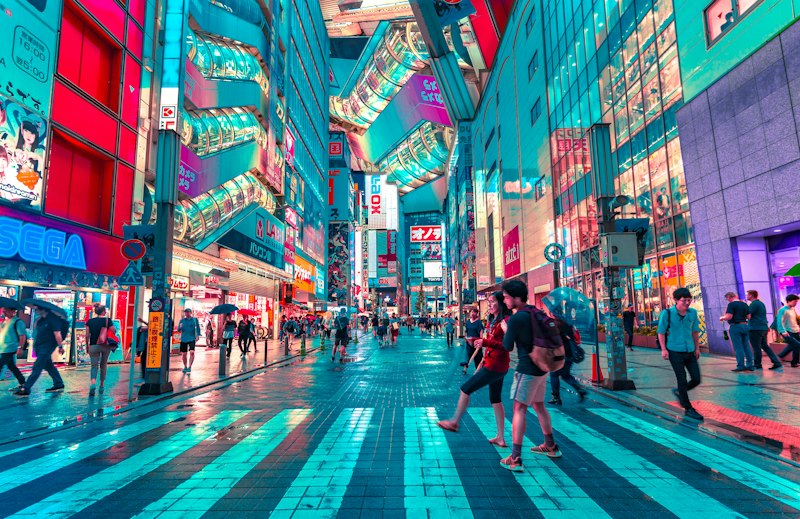
If you want the boutique experience—the white camellia flower packaging, the sparkling water, and your name registered in Chanel’s global system—you need to visit an official boutique. Be warned: stock for black Classic Flaps is notoriously low. You must arrive exactly at opening time, and you may need to wait in a physical queue or join a digital waitlist via a QR code at the door.
1. Chanel Ginza Namiki Flagship
This is the crown jewel of Chanel in Japan. Located on Namiki-dori (Ginza’s ultra-exclusive, quieter luxury street), this multi-story architectural marvel features custom artwork, VIP salons, and arguably the largest allocation of handbag stock in the country. Because it is a standalone boutique, you will get the full 10% tax refund with no department store fees.
- Estimated 2026 Price (Medium Classic Flap): 1,485,000 JPY (Tax-inclusive).
- Opening Hours: 12:00 PM to 7:00 PM daily.
- Exact Access: A 3-minute walk from Ginza Station (Tokyo Metro Ginza, Marunouchi, and Hibiya lines). Take Exit B5, walk straight toward the Sony Building intersection, turn right onto Namiki-dori, and the striking black-and-white Chanel facade will be on your left.
2. Chanel Omotesando
Housed in the Gyre building on Tokyo’s bustling, tree-lined Champs-Élysées equivalent, the Omotesando boutique is massive and frequently receives seasonal, trendy runway pieces alongside the classics. It attracts a younger, highly fashionable crowd.
- Opening Hours: 11:00 AM to 8:00 PM daily.
- Exact Access: A 5-minute walk from Omotesando Station (Chiyoda, Ginza, Hanzomon lines) Exit A1. Walk straight down Omotesando Avenue toward Harajuku. The boutique occupies the ground floor of the Gyre building on your left, just before the pedestrian footbridge.
3. Shinjuku Isetan Chanel Boutique
Isetan Shinjuku is the highest-grossing department store in Japan. The ground-floor Chanel boutique here is perpetually busy. While they get frequent restocks due to their massive sales volume, you will have to pay Isetan’s 1.55% tax refund administration fee.
- Opening Hours: 10:00 AM to 8:00 PM.
- Exact Access: Directly connected to Shinjuku-sanchome Station (Marunouchi, Fukutoshin, Shinjuku lines) via the underground passage. If coming from JR Shinjuku Station, take the East Exit and walk 5 minutes straight down Shinjuku-dori.
(Pro-Tip: If you plan on buying luxury cosmetics or other non-Chanel items at department stores, look into 7 Best Free Klook Shopping Coupons for Japan in 2026 to see if you can stack tourist discounts on top of tax-free savings at affiliated retailers like Matsuya or Keio.)