[PR] This article contains affiliate links.
Stepping onto the sacred grounds of Fushimi Inari Taisha is to step into the very spiritual heartbeat of Kyoto. Renowned globally for its seemingly endless pathways of vermilion gates winding into a deep, forested mountainside, this is a destination that transcends typical sightseeing. For centuries, it has drawn millions of worshipers seeking prosperity, bountiful harvests, and business success. Today, it stands as one of Japan’s most iconic and deeply revered cultural landmarks, an absolute must-visit for any inbound traveler.
However, fully experiencing Fushimi Inari Taisha requires more than just showing up with a camera. This is an active, deeply sacred Shinto precinct governed by strict etiquette, steeped in over a millennium of history, and spread across a vast mountain trail.
This exhaustively researched 2026 guide will cover everything you need to know: from navigating the official visitor rules and understanding the profound history of the Inari faith, to step-by-step trail guidance for scaling the sacred mountain.
1. Fushimi Inari Taisha: The Head Shrine of 30,000
While you may see Inari shrines dotted across Japan—often recognizable by their fox statues and vermilion gates nestled in city alleys or deep countryside—Fushimi Inari Taisha is the paramount center of this specific faith.
There are an estimated 30,000 Inari shrines throughout Japan, creating a massive nationwide network of devotion. Fushimi Inari Taisha serves proudly as the head shrine of all of them. When you walk these grounds, you are standing at the absolute epicenter of a spiritual tradition that touches every corner of the Japanese archipelago.
A History Spanning Over 1,300 Years
The story of Fushimi Inari Taisha begins in the early 8th century. The shrine was officially founded in 711 AD, a period preceding Kyoto becoming the imperial capital of Japan. The immense historical weight of this location was celebrated globally when the 1300th anniversary of the enshrinement was marked in 2011.
Through the centuries, the deity worshiped here, Inari Okami, rose to extraordinary prominence within the Shinto hierarchy. Historical records indicate that Inari Okami received the junior fifth court rank in the year 827. Due to deep imperial reverence and the deity's growing importance to the agrarian and commercial success of the nation, Inari Okami was elevated to the highest possible rank, Sho-ichii, in 942. This supreme rank solidified the shrine's elite status, a prestige that continues to define its operations and maintenance today.
2. Scale and Scope: Understanding the Shrine Grounds
When planning your visit, it is vital to understand that Fushimi Inari Taisha is not a single building or a compact courtyard. It is a sprawling, multi-layered spiritual complex.
The official precinct size is immense: approximately 870,000 square meters. To put this vast scale into perspective, the shrine itself describes the grounds as being roughly 22 times the size of Koshien Stadium, one of Japan's largest and most famous baseball parks.
This massive precinct includes the extensive area situated west of the mountain's base—where the majestic Main Hall (Honden) and major shrine administration buildings sit—as well as the entirety of the sacred mountain that towers behind it.
The Sacred Mountain: Inariyama
The shrine's grounds are fundamentally centered on Inariyama (Mount Inari). Reaching a height of 233 meters, Inariyama is geographically significant as the southernmost of Kyoto's famous "36 Higashiyama Mountains" (the mountain range that borders the eastern edge of the Kyoto basin).
The mountain is not merely a backdrop for the shrine; the mountain is the sacred space. The trails that snake up to the 233-meter summit are lined with smaller sub-shrines, stone altars (otsuka), and the world-famous vermilion gates, transforming the physical hike into a spiritual pilgrimage.
Admission and Operating Hours
Fushimi Inari Taisha is an active Shinto shrine with an incredibly open layout. The official site does not explicitly print "free" regarding admission, nor does it state specific opening or closing hours for the main grounds. By tradition and physical layout, the shrine is an open precinct, meaning the mountain trails and the main grounds are understood to be accessible at all times without a general admission gate or ticketing booth.
However, inbound tourists should strictly treat specific hours claims—such as the operating hours for the shrine office, the places dispensing amulets (omamori), or prayer services—as unconfirmed until checking on-site signage. Facilities that offer spiritual services and items will have distinct daytime operating hours, even if the mountain paths themselves remain open to the quiet night air.
3. Getting There: Detailed Access Guide for 2026
Situated in the Fushimi ward of southern Kyoto, the shrine is incredibly well-connected by public transit. In fact, due to the heavy volume of visitors, the official site strongly recommends utilizing public transport, noting that nearby parking lots are frequently full (and parking is strictly reserved for shrine visitors only).
If you are using public transit, tapping in with an IC card makes travel seamless. Be sure to review What is the Best IC Card for Tourists in Japan 2026? | Suica vs Pasmo vs ICOCA before navigating Kyoto's rail networks.
By JR (Japan Railways) - Highly Recommended
The most straightforward route from central Kyoto is via the JR Nara Line.
- Station: Inari Station
- Distance from Kyoto Station: It is merely 2 stops away, taking about 5 minutes.
- Access: Inari Station is immediately adjacent to the shrine. As soon as you exit the ticket gates, the grand torii marking the entrance to the precinct is right in front of you.
By Keihan Electric Railway
If you are coming from eastern Kyoto areas like Gion-Shijo or Sanjo, or traveling up from Osaka, the Keihan Main Line is an excellent choice.
- Station: Fushimi-Inari Station
- Access: The station is about a 5-minute walk west of the shrine. The walk takes you through a lively neighborhood road filled with local vendors and traditional architecture.
By Kyoto City Bus
While buses in Kyoto can be subject to traffic, they are a viable option if departing from certain sectors of the city.
- Route: Minami 5 line
- Stop: Inari Taisha-mae
- Access: After disembarking, it is about a 7-minute walk east to reach the main shrine grounds.
By Car (Not Recommended for Tourists)
While driving is highly discouraged for visitors due to congestion, for those who must, the shrine is accessible via major expressways:
- About 20 minutes from the Kyoto Minami Interchange on the Meishin Expressway.
- About 10 minutes from the Kamitoba Exit on the Hanshin Expressway.
- Note again: Parking is strictly for shrine visitors, and lots are frequently at capacity. Do not plan on using the shrine's parking as a base to visit other areas of Kyoto.
4. The Vermilion Gates: Unraveling the Numbers and the "Senbon Torii"
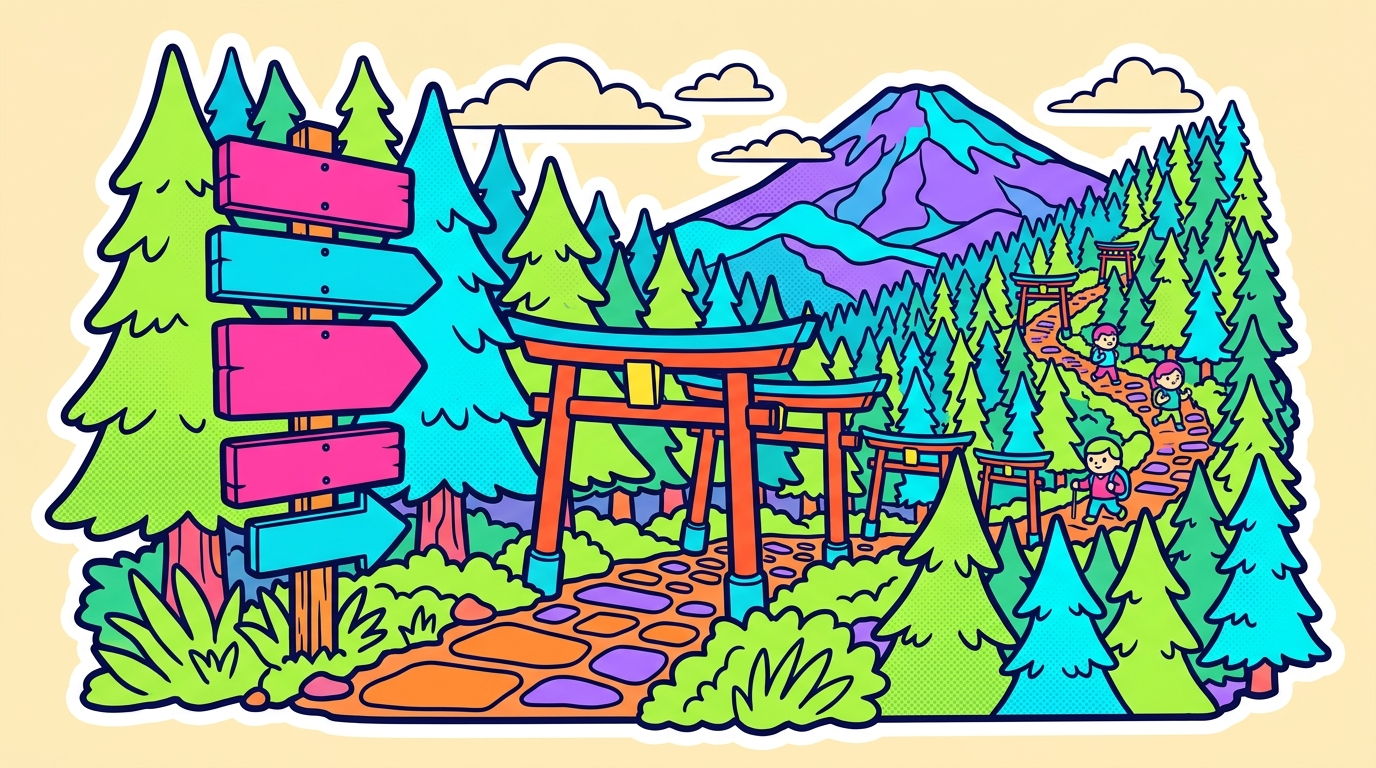
The defining visual characteristic of Fushimi Inari Taisha is undoubtedly the winding, tunnel-like pathways of brilliant vermilion torii gates contrasting against the dense green forest of Inariyama.
For decades, travel blogs and guidebooks have thrown out wild, highly specific numbers regarding exactly how many gates exist on the mountain, sometimes confidently claiming precise figures like "32,000." These are not official.
According to the shrine's own official FAQ, "about 10,000 torii of various sizes line the mountain paths." This is the single, verified approximate figure provided by the shrine itself. The environment is a living, breathing space; wooden gates naturally weather, are replaced, or new ones are dedicated by worshipers. Therefore, the shrine refers only to "approximately 10,000," and visitors should appreciate the staggering scale without seeking an exact literal count.
What is the "Senbon Torii"?
A common point of confusion for tourists is the phrase "Senbon Torii." Because "Senbon" literally translates to "thousand" in Japanese, many visitors mistakenly believe this is a literal gate count or the total number of gates on the mountain.
It is not a literal count. "Senbon Torii" is simply a place name.
It refers to one specific gate-lined path section—a dense, bifurcated (split into two) tunnel of gates located shortly behind the main grounds as you begin to ascend. This particular section is mapped on the official site as a named location, functioning as a beautiful gateway into the deeper mountain paths. It should never be used as evidence for an exact total number of gates across the sprawling 870,000-square-meter precinct.
5. The 17 Official Prohibited Acts (Etiquette for Inbound Tourists)
Because of the massive influx of visitors, and to preserve the sacred dignity of the 1,300-year-old grounds, Fushimi Inari Taisha implemented a strict set of visitor rules effective January 1, 2022.
There are 17 prohibited acts total listed by the shrine. Ignorance of these rules is not an excuse. While foreign visitors are enthusiastically welcomed, it is absolutely paramount that you respect the space.
Below is an etiquette callout box detailing the selected highlights verified verbatim from the official rules list. Ensure you follow every single one:
🛑 Fushimi Inari Taisha Official Visitor Rules (Effective Jan 1, 2022)
The following selected highlights are verbatim prohibitions from the shrine's official 17-point rule list:
- No smoking/fires: The precinct is heavily forested; fire is a grave danger to the ancient wooden structures.
- No entering restricted areas: This includes the Main Hall, other buildings, and areas beyond fences without explicit permission.
- No flying drones/aircraft: Drone photography is strictly banned to ensure safety and quiet worship.
- No damaging buildings, torii gates, trees, or similar property: Do not carve your name into gates, lean heavily on fragile wooden structures, or pluck tree branches.
- No leaving strollers unattended outside marked areas: Keep the paths clear and safe.
- No eating/drinking outside marked free-rest areas, including while walking: Do not consume street food while traversing the torii gates or mountain paths.
- No littering: Take your trash with you or use designated bins if provided in rest areas.
- No parking in shrine lots (including Lots 1 and 4) unless visiting the shrine: Parking is strictly enforced.
- No approaching/feeding wild birds or animals: You may see cats or local wildlife on the mountain; leave them completely alone.
- No pets except guide dogs: Keep personal pets off the shrine grounds.
- No commercial photography or photography in prohibited areas: Observe all "no photo" signs near altars and inner buildings.
- No wedding dresses/costumes inappropriate for worship: This is a place of Shinto worship, not a mere photo studio. Inappropriate or overly theatrical costumes are banned.
- No unauthorized surveys/questionnaire distribution: Respect the privacy of other worshipers.
- No blocking narrow paths for photos/filming: The paths must remain passable. Do not set up tripods that block traffic or force crowds to halt so you can get a perfect empty shot.
Always remember that your status as a tourist does not supersede your responsibilities as a guest in a sacred space. Bringing coins for shrine offerings is traditional, so check Cash vs Card in Japan 2026: How Much Cash Do You Need? to prepare.
6. The Inariyama Mountain Trail Guide: Step-by-Step
Navigating the approximately 10,000 torii up the 233-meter high Inariyama is an awe-inspiring journey. While the official site does not dictate a required or officially recommended visit duration, general travel experience suggests seasoned travelers allow roughly 2 to 3 hours to hike the full loop to the summit and back. (Please note this timeframe is purely from general travel consensus and your own pace will vary greatly depending on fitness, crowds, and weather).
Here is a breakdown of the key map-spot names provided by the shrine to help you track your progress up the 36 Higashiyama Mountains' southernmost peak.
Base Level: The Main Hall (Honden)
Your journey begins at the base of the mountain, entering from JR Inari Station or the Keihan line approach. Here you will find the grand Romon Gate and the spectacular Main Hall. This area represents the primary ceremonial heart of Fushimi Inari Taisha. Before beginning your hike, pay your respects here.
The Entry to the Mountain: Senbon Torii
Just behind the main shrine buildings, you will find the entrance to the mountain paths. The trail quickly funnels into the Senbon Torii section. As noted, this is a specific place name characterized by two dense, parallel rows of gates tightly packed together. The visual effect here is profound, with the sunlight filtering through the vermilion wood, creating an otherworldly glow. Because this is the most famous photo spot, remember Rule #14: No blocking narrow paths for photos. Keep moving and be considerate.
First Plateau: Okusha Shrine
After emerging from the Senbon Torii section, you arrive at the Okusha Shrine (often called the inner shrine). This area acts as a gateway to the deeper reaches of Inariyama. It is well-known among Japanese visitors for housing the "Omokaru Stone" (heavy-light stone). Visitors make a wish and lift the stone lantern's top; it is said that if the stone feels lighter than expected, the wish will come true.
The Crossroads: Yotsutsuji Intersection
Continuing up the mountain trail, the path consists of hundreds of stone stairs flanked continuously by vermilion gates. The ascent becomes notably steeper. About midway up the 233-meter mountain, you will reach Yotsutsuji.
This intersection is a major resting point. Here, the dense forest breaks, offering a spectacular panoramic view out over the Kyoto basin. From Yotsutsuji, the trail splits into a circular loop that leads to the summit and back down to this exact intersection. This is a great place to catch your breath and hydrate. (Curious about local hydration? See Can You Drink Tap Water in Japan? | City by City Guide 2026).
The Peak: Inariyama Summit
Taking either path from Yotsutsuji will eventually lead you to the highest point of the precinct. At 233 meters up, the summit houses the Kamisha (Upper Shrine). Many first-time visitors expect a massive viewing platform at the top; however, the summit is deeply spiritual, surrounded by dense trees, stone altars, and thousands of miniature torii gates left as offerings by businesses and individuals. Reaching the summit is a fulfilling accomplishment and the ultimate act of devotion for those trekking the mountain.
The Descent: Kojingamine and Surrounding Paths
As you loop back down toward Yotsutsuji, the trail often passes through Kojingamine, another beautifully serene map-spot offering different vantage points and quieter stretches of torii tunnels. The descent is generally faster, but the uneven stone steps require sturdy footwear. Avoid rushing, as doing so increases the risk of tripping, potentially violating Rule #4 (damaging property) if one were to fall into a fragile wooden structure.
7. Maximizing Your Shrine Experience

A visit to Fushimi Inari Taisha pairs incredibly well with exploring the broader historical canvas of Kyoto. If you are comparing massive, iconic Kyoto landmarks, reading the Ultimate Arashiyama Travel Guide 2026: Bamboo Grove, Tenryu-ji & Togetsukyo Bridge will provide great contrast between eastern Kyoto's spiritual mountains and western Kyoto's bamboo forests.
Dining Restrictions and Planning
Because the 2022 rules strictly forbid eating or drinking outside marked free-rest areas (including absolutely no eating while walking), you must plan your meals accordingly. You cannot buy street food on the approach and eat it while walking through the Senbon Torii.
Travelers with specific dietary needs should plan to eat in proper sit-down establishments either before approaching the shrine or after leaving. For those navigating dietary restrictions in Japan, our Allergy Travel Japan | Nut Egg Dairy Free Dining with Translation Cards guide offers vital resources for safely ordering in the neighborhood restaurants situated around Keihan Fushimi-Inari Station.
What to Wear on the Mountain
Since Fushimi Inari Taisha is fundamentally a mountain hike encompassing a 233-meter ascent up Inariyama, your attire should balance respect for a Shinto shrine with athletic practicality.
- Footwear: Sturdy, comfortable walking shoes are mandatory. The steps can be uneven, and in humid or damp weather, the stone can become slick.
- Clothing: Dress in breathable layers. Kyoto's summers are notoriously hot and humid, while winters can be sharply cold. Remember Rule #12 regarding inappropriate costumes—keep your attire respectful and suited for a physical hike through a religious site.
8. Official Fushimi Inari Taisha FAQ Highlights
To ensure visitors have accurate information, we have compiled an FAQ pulling from the overarching themes addressed in the shrine's own official Q&A content and verified facts:
Q: Are there exactly 10,000 torii gates? A: No. The official shrine states that "about 10,000 torii of various sizes line the mountain paths." It is an approximate figure meant to convey the vast, uncountable scale of the offerings across the mountain, not an exact inventory count.
Q: What is the significance of the rank "Sho-ichii"? A: In the ancient Japanese court ranking system, Sho-ichii was the absolute highest rank achievable. Inari Okami received the junior fifth court rank in 827, and was elevated to Sho-ichii in 942, reflecting the tremendous historical importance of the deity to the state and the people.
Q: Can I fly my drone to get a video of the torii tunnels? A: Absolutely not. According to the 17 prohibited acts (effective Jan 1, 2022), flying drones or any aircraft over the 870,000-square-meter precinct is strictly forbidden.
Q: Can I walk the mountain trails at night? A: Fushimi Inari Taisha is traditionally an open precinct with no stated closing hours for the main grounds or mountain paths. However, the mountain is dark, uneven, and heavily forested. If you choose to walk in the evening, use extreme caution, stay on marked paths, and maintain complete silence and respect for the sacred environment. Be aware that shrine offices and shops will not be open.
Q: Where should I park my rental car? A: The official site recommends using public transport. While there are parking lots for the shrine, they are exclusively for shrine visitors and are frequently full. Under the Jan 1, 2022 rules, parking in shrine lots (including Lots 1 and 4) unless visiting the shrine is strictly prohibited. Take the JR Nara line to Inari Station instead.
Q: Is "Senbon Torii" the name of the whole mountain path? A: No. Senbon Torii (meaning "thousand torii") is a specific place name referring to the dense, bifurcated tunnel of gates located shortly behind the main grounds. It does not represent the literal count of gates on the mountain.
A Final Thought on Respecting the Head Shrine
Fushimi Inari Taisha is a triumph of devotion, an 870,000-square-meter precinct where history, nature, and faith converge. As you walk the path from the Main Hall, through the Senbon Torii, up to the Yotsutsuji intersection, and finally reach the 233-meter summit of Inariyama, you are participating in a tradition that spans over 1,300 years.
By strictly adhering to the 17 official rules, relying on public transport like the Keihan or JR lines, and understanding the profound context of this head shrine of 30,000 Inari branches across Japan, you ensure that this sacred Kyoto mountain remains pristine for the next millennium.
FAQ
Q: Are there exactly 10,000 torii gates?
No. The official shrine states that about 10,000 torii of various sizes line the mountain paths. It is an approximate figure meant to convey the vast, uncountable scale of the offerings across the mountain, not an exact inventory count.
Q: What is the significance of the rank Sho-ichii?
In the ancient Japanese court ranking system, Sho-ichii was the absolute highest rank achievable. Inari Okami was elevated to Sho-ichii in 942, reflecting the tremendous historical importance of the deity to the state and the people.
Q: Can I fly my drone to get a video of the torii tunnels?
Absolutely not. According to the 17 prohibited acts (effective Jan 1, 2022), flying drones or any aircraft over the 870,000-square-meter precinct is strictly forbidden.
Q: Can I walk the mountain trails at night?
Fushimi Inari Taisha is traditionally an open precinct with no stated closing hours. However, the mountain is dark, uneven, and heavily forested. If walking in the evening, use extreme caution, stay on marked paths, and maintain complete silence.
Q: Where should I park my rental car?
The official site recommends using public transport like the JR Nara line. Shrine parking lots are exclusively for shrine visitors and are frequently full. Parking in shrine lots unless visiting the shrine is strictly prohibited.
Q: Is Senbon Torii the name of the whole mountain path?
No. Senbon Torii (meaning thousand torii) is a specific place name referring to the dense, bifurcated tunnel of gates located shortly behind the main grounds. It does not represent the literal count of gates on the mountain.