[PR] This article contains affiliate links.
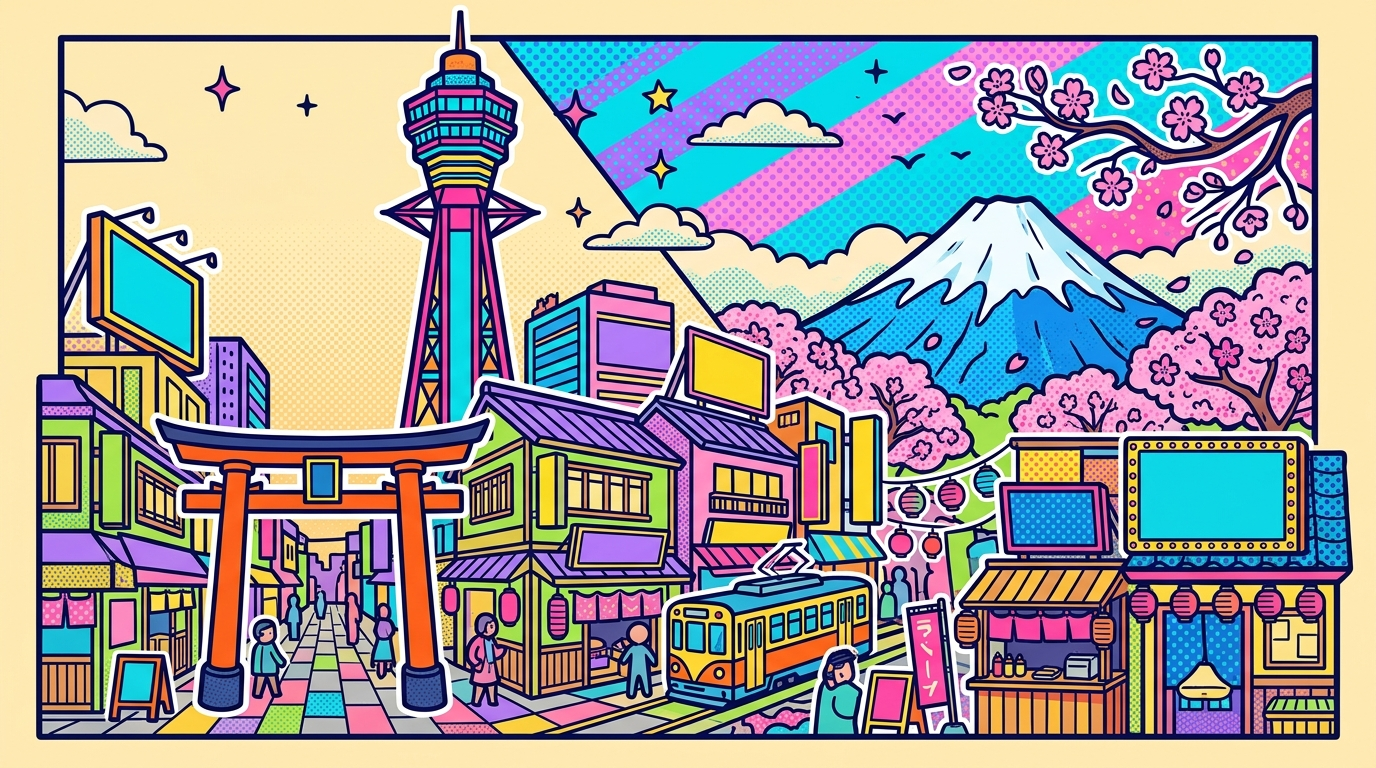
If you want to understand the true, unfiltered soul of Osaka, you have to look past the gleaming skyscrapers of Umeda and the polished tourist corridors of Shinsaibashi. You have to head south to Naniwa Ward, where the neon is a little brighter, the atmosphere is a little louder, and the skyline is dominated by an unmistakable octagonal steel structure. Welcome to Tsutenkaku Tower and the surrounding Shinsekai district—the undisputed champions of retro Osaka.
For international tourists mapping out their Japanese itineraries, Tsutenkaku is more than just an observation deck; it is a time capsule. Translating to the "Tower Reaching to Heaven," Tsutenkaku stands as the geographic and spiritual centerpiece of Shinsekai (which literally means "New World"). This freely walkable, public street district requires no admission fee to explore and offers a dizzying, Showa-era (1926–1989) carnival atmosphere that you simply cannot find anywhere else in Japan. Here, the scent of fried meat and sweet sauce fills the air, massive 3D signs loom overhead, and the concept of "too much" simply does not exist.
However, planning a trip to this iconic destination requires the most up-to-date information. As Japan’s tourism landscape shifts rapidly, Tsutenkaku Tower has implemented significant operational updates for the 2026 season. If you are relying on outdated travel blogs from 2024 or 2025, you are going to show up with the wrong budget and at the wrong time.
This exhaustive, extremely deep 2026 visitor guide provides everything you need to know about navigating Tsutenkaku Tower, exploring the retro wonderland of Shinsekai, mastering the local dining etiquette, and planning your Osaka itinerary with absolute precision.
Part 1: Tsutenkaku Tower – The Official 2026 Visitor Guide
Tsutenkaku is not the tallest tower in Japan—at 103 meters, it is dwarfed by the Tokyo Skytree and even nearby Abeno Harukas. But what it lacks in vertical dominance, it makes up for in sheer character, history, and quirky Osaka charm.
Crucial 2026 Updates: Prices and Hours Have Changed
It is imperative to note that operating hours for the general observation deck changed as of March 1, 2026, and admission fees for the general observation deck changed (increased) as of April 1, 2026. Any pre-2026 prices or hours you find on older forums, outdated guidebooks, or obsolete travel videos are fundamentally incorrect.
Here are the official, verified details for 2026:
Official 2026 General Observation Deck Admission (Standard Period):
- Adult (Age 15 and up): 1,500 yen
- Child (Ages 5–14): 800 yen
Official 2026 Year-End/New Year Peak Pricing: If you are visiting during the busy holiday season—specifically from December 30, 2026, through January 3, 2027—be prepared for peak pricing. During this window, admission rates are slightly higher to manage crowd control and holiday operations:
- Peak Adult (Age 15 and up): 1,800 yen
- Peak Child (Ages 5–14): 900 yen
Official 2026 General Observation Deck Operating Hours:
- Hours of Operation: 9:00 AM – 21:45 (9:45 PM)
- Last Admission: 21:15 (9:15 PM)
- Note: These are the hours for the main observation deck only. Add-on attractions may vary.
Facility Details:
- Address: 1-18-6 Ebisu-higashi, Naniwa-ku, Osaka, 556-0002
- Official Phone: 06-6641-9555
- Access Overview: A short walk from Ebisucho Station (Sakaisuji Line) or Dobutsuen-mae Station (Midosuji Line).
The Experience: What to Expect Inside the Tower
Your journey begins at the base of the tower. After purchasing your ticket and taking the elevator up, you are instantly transported into an eccentric world.
The Golden Observation Deck (5th Floor): Sitting 87.5 meters above the ground, this main observation floor is entirely—and unapologetically—painted gold. The views of Osaka are spectacular, allowing you to gaze down at the sprawling Tennoji Park, the dense urban grid of southern Osaka, and the glittering neon of Shinsekai right beneath your feet.
The Light Observation Deck (4th Floor): At 84 meters up, this floor transitions from daytime views to a dazzling light display as the sun goes down. It resembles an old-school disco, capturing the neon-drenched retro-futurism that defined Japan in the late 1980s.
The Cultural Icon: Meeting Billiken
You cannot visit the Tsutenkaku observation deck without paying your respects to Billiken, the "God of Things As They Ought To Be." Interestingly, Billiken is not a traditional Japanese deity. The character was actually created by an American art teacher named Florence Pretz in 1908. The quirky, smiling figure with pointed ears and a tuft of hair became a massive fad in the United States and was eventually brought over to Japan.
Billiken was installed in the original Luna Park amusement park in Shinsekai in 1912 and became the beloved patron saint of the district. Today, a wooden statue of Billiken sits proudly on the 5th-floor observation deck of Tsutenkaku.
Cultural Note: It is a time-honored tradition to rub the bottom of Billiken's bare feet for good luck. You will notice that his feet are worn smooth from millions of hopeful visitors making a wish.
Thrill Seekers Beware: TOWER SLIDER and DIVE&WALK (2026 Warning)
In recent years, Tsutenkaku has attempted to rebrand itself from a simple observation tower into an active thrill destination by adding two major paid add-on experiences: the TOWER SLIDER (a massive spiral slide wrapping around the exterior of the tower) and the DIVE&WALK (an outdoor harness experience where guests walk on an exposed upper rim).
Important 2026 Disclaimer on Add-On Prices and Hours: If you are planning your budget, you must exercise extreme caution regarding these two attractions. While some secondary reseller listings and travel blogs cite figures around ¥1,100 for an adult TOWER SLIDER ticket and roughly ¥3,000 for an adult DIVE&WALK experience, these numbers could not be confirmed directly from the official attraction pages during our 2026 verification. Furthermore, we found reseller figures hinting at discounted combination/set-ticket bundles (e.g., Observation Deck + Slider + Dive), but these also could not be verified as official, currently valid prices.
To avoid budget surprises, you must check the official Tsutenkaku website’s dedicated TOWER SLIDER and DIVE&WALK pages for current pricing before you go, or inquire on-site about bundle options.
Cost Comparison: Assuming the unconfirmed reseller figures are somewhat accurate, a thrill-seeking adult would spend the standard ¥1,500 base admission, plus an estimated ¥1,100 for the slide, and roughly ¥3,000 for the outdoor walk. This means engaging in the full Tsutenkaku extreme experience could escalate your cost from a modest 1,500 yen to a steep 5,600+ yen per person. If you are traveling with a family, sticking to the standard observation deck ticket remains the most cost-effective way to enjoy the tower.
Operational Volatility and Hours: Do not assume these add-on attractions operate on the same 9:00–21:45 schedule as the main observation deck. Secondary sources indicate they often run on completely different, much shorter hours, and require separate safety briefings. More importantly, do not assume the DIVE&WALK or TOWER SLIDER operate every day without exception. Our 2026 research found at least one documented temporary full-day closure for these attractions on a specific 2026 date due to maintenance or weather conditions.
If your entire reason for visiting Tsutenkaku is to ride the slide or walk the exterior, you must check the official site's daily notices on the morning of your visit to confirm they are open.
Part 2: Welcome to Shinsekai – Osaka’s Retro Wonderland
Directly beneath the steel legs of Tsutenkaku Tower lies Shinsekai. Developed in 1912, the district was intentionally modeled after two global powerhouses: the northern half was inspired by the romantic streets of Paris (complete with the original Tsutenkaku mimicking the Eiffel Tower), and the southern half was modeled after New York's Coney Island.
Over the decades, Shinsekai weathered fires, war, and economic downturns. While the original Luna Park closed in 1923, the entertainment spirit never left. Today, Shinsekai is a vibrant, freely walkable public street district with no admission gates and no entry fees. It is famous for its exaggerated, 3D restaurant signage (think giant mechanical crabs, massive paper lanterns shaped like blowfish, and towering sumo wrestlers), bustling pachinko parlors, and, most importantly, its food.
The Kushikatsu Culture of Shinsekai
You cannot visit Shinsekai without eating kushikatsu. This quintessential Osaka street food consists of skewered meats, seafood, and vegetables coated in a light panko batter and deep-fried to golden perfection.
Historically, kushikatsu was created as a cheap, filling, and fast meal for the blue-collar laborers rebuilding Osaka after the war. The thick batter and rich sauce provided heavy calories for cheap prices. Today, it has been refined into a beloved culinary art form, but its unpretentious, working-class roots remain.
The Golden Rule: NO DOUBLE DIPPING (Nido-zuke Kinshi) When you sit down at a traditional kushikatsu restaurant, you will be presented with a large, communal stainless-steel tin filled with a thin, sweet, and savory Worcestershire-style sauce.
Here is the most critical cultural note for your trip: You are strictly forbidden from dipping your skewer into the communal sauce tin more than once. Because the sauce is shared with the next customer who sits at your seat, putting a half-eaten skewer back into the tin is a massive health hazard and a profound breach of etiquette.
How to eat it properly:
- Take your freshly fried skewer.
- Submerge it entirely into the sauce tin one time.
- Bring it to your plate and eat it.
- If you need more sauce, use the complimentary raw cabbage leaves provided at your table as a makeshift spoon to scoop sauce from the tin and drizzle it over your food. (And yes, you eat the crisp cabbage, which helps cut through the heavy oil of the fried food!).
Note: In the post-pandemic era, some restaurants have switched from communal tins to squeeze bottles. However, the cultural memory of "no double dipping" remains a point of pride in Shinsekai, and the old-school establishments still enforce the communal tin rules strictly.
Part 3: Deep Dive – Where to Eat and Drink in Shinsekai (2026 Specific Locations)
Navigating the dense concentration of restaurants in Shinsekai can be overwhelming. To help you plan, here are highly recommended, accessible locations for international tourists, complete with exact access details, estimated 2026 pricing, and interactive maps.
1. Kushikatsu Daruma – Shinsekai Sohonten (The Original)
If there is one name synonymous with Shinsekai, it is Daruma. Established in 1929, this is widely considered the birthplace of modern Osaka kushikatsu. The "Sohonten" (original main branch) is tiny, seating only a handful of people at a counter, giving it an incredibly intimate and historic feel. Look for the statue of the angry-looking owner out front holding two skewers (his expression is a reminder not to double-dip!).
- What to Order: The classic beef skewer (Ganso Kushikatsu), lotus root (renkon), and quail eggs (uzura). Don't skip the doteyaki (beef sinew stewed in a sweet white miso paste)—it is a Shinsekai staple.
- Estimated Price: Skewers range from ¥150 to ¥250 each. A hearty meal with a draft beer will cost around ¥2,000–¥3,000.
- Hours: 11:00 AM to 22:30 (10:30 PM).
- Access: A 4-minute walk south from Ebisucho Station (Exit 3). It is tucked in a narrow alley just steps from Tsutenkaku.
2. Yaekatsu (Janjan Yokocho Alley)
For a slightly different vibe, head to Janjan Yokocho, a narrow, covered arcade street at the southern edge of Shinsekai. Yaekatsu is arguably the most popular spot here, often boasting a queue of locals before it even opens. The batter here is known for being slightly fluffier, incorporating yam into the mix for a delicate crunch.
- What to Order: Jumbo shrimp (ebi), asparagus, and their legendary doteyaki, which bubbles away in a massive vat right in front of the counter.
- Estimated Price: ¥150 to ¥450 per skewer.
- Hours: 10:30 AM to 20:30 (8:30 PM). Closed Thursdays.
- Access: A 3-minute walk north from Dobutsuen-mae Station (Exit 1), located right inside the Janjan Yokocho arcade.
3. Tengu
Located quite literally right next door to Yaekatsu in Janjan Yokocho, Tengu is the eternal rival. While Yaekatsu is famous for its fluffy batter, Tengu is renowned for its heartier, crisper finish and incredibly savory sauce. Many Osaka locals will fiercely debate whether Yaekatsu or Tengu is superior—try both if you have the stomach space!
- What to Order: The beef cutlet and the fried wiener sausage.
- Estimated Price: ¥150 to ¥300 per skewer.
- Hours: 10:30 AM to 21:00 (9:00 PM). Closed Mondays.
- Access: Adjacent to Yaekatsu in Janjan Yokocho, 3 minutes from Dobutsuen-mae Station.
(Planning your food budget for these restaurants? Read our deep dive: How Much Does Food Cost in Japan? 2026 Konbini vs Restaurant to see how local street food stacks up against convenience store dining.)
4. Sennariya Coffee (Retro Kissaten & Mixed Juice)
Shinsekai isn't only about deep-fried meat. It is also the birthplace of Osaka's famous "Mixed Juice" (Mikkusu Jusu). Sennariya Coffee, established in 1948, is the historic kissaten (retro Japanese coffee shop) credited with inventing this sweet, creamy blend of milk, bananas, oranges, and peaches. The interior is wonderfully nostalgic, with velvet seats, low lighting, and the aroma of siphon coffee.
- What to Order: The original Mixed Juice, and a slice of thick-cut Japanese toast.
- Estimated Price: Mixed Juice is approximately ¥550.
- Hours: 9:00 AM to 21:00 (9:00 PM).
- Access: Located near the northern entrance of Janjan Yokocho. 4 minutes walking from Dobutsuen-mae Station.
(If you have dietary restrictions while traveling through Japan's street food districts, be sure to check our guide: Allergy Travel Japan | Nut Egg Dairy Free Dining with Translation Cards for help navigating local menus.)
Part 4: Beyond Food – Retro Entertainment in Shinsekai
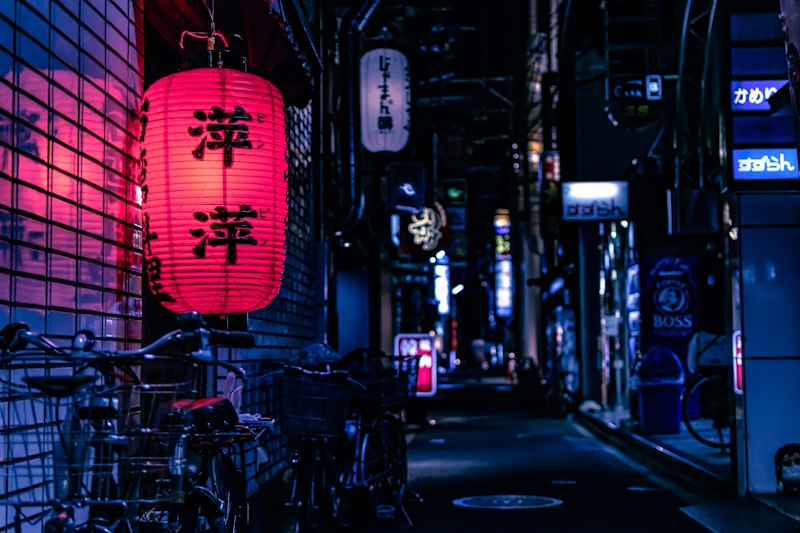
The Shinsekai experience is highly visual and auditory. The clatter of pachinko balls, the mechanical music of old arcade games, and the chatter of locals playing shogi (Japanese chess) on the street corner are all part of the charm.
5. Smart Ball News Star
Before the modern, high-tech pachinko machines took over Japan, there was "Smart Ball." Think of it as a low-tech, horizontal mix between pinball and pachinko. The player uses a physical lever to launch glass balls across a wooden board dotted with nails and scoring holes. Smart Ball News Star is one of the very last remaining parlors of its kind in all of Japan.
It is entirely analog, surprisingly addictive, and incredibly cheap entertainment. It is completely legal for adults and offers a glimpse into post-war Japanese leisure.
- How to Play: Insert ¥100 into the machine, and 25 glass balls will drop out. Pull the spring lever to launch them. If a ball lands in a winning pocket, more balls cascade out. If you win enough, you can trade the balls in for retro candy or small toys at the counter.
- Estimated Price: ¥100 per game (25 balls).
- Hours: 10:00 AM to 21:30 (9:30 PM). Note: Must be 18 or older to enter.
- Access: Right in the heart of Shinsekai, about a 2-minute walk south of Tsutenkaku Tower.
6. Super Tamade Ebisuten (The Neon Supermarket)
While it is technically a grocery store, Super Tamade is a visual spectacle and an Osaka institution. Famous for its blinding yellow and red neon signs, cheap prices, and slightly chaotic layout, it is an essential stop for tourists wanting to see where locals actually shop. It is also an amazing place to buy cheap Osaka souvenirs, Japanese snacks, and discounted bento boxes.
- What to Buy: Cheap local snacks, discounted late-night sushi, and unique Japanese drinks.
- Hours: Open 24 Hours.
- Access: Located on the eastern edge of Shinsekai, about 5 minutes from Tsutenkaku.
(Curious about the safety of local food and drink in these older neighborhoods? Read our guide: Can You Drink Tap Water in Japan? | City by City Guide 2026.)
Part 5: Practical Access Guide – How to Get to Tsutenkaku & Shinsekai
Navigating Osaka is generally straightforward, but because Shinsekai is nestled between several major transit lines, tourists often get confused about which station is best.
The Official Address Reminder: 1-18-6 Ebisu-higashi, Naniwa-ku, Osaka.
Depending on where you are staying in the city, here are the best ways to access the district:
Option 1: From Umeda/Osaka Station (The North Hub)
If you are coming from the northern hub of Umeda, the easiest route is the Midosuji Subway Line.
- Take the Midosuji Line southbound from Umeda Station to Dobutsuen-mae Station.
- Ride duration: ~12 minutes.
- Cost: ¥240.
- Take Exit 1. From here, you will walk straight into the Janjan Yokocho arcade, which slowly reveals the towering view of Tsutenkaku as you walk north. This is the most dramatic and highly recommended way to enter the district.
Option 2: From Namba/Dotonbori (The Central Hub)
If you are already exploring the central Namba area, you have two great options:
- Nankai Railway: Take the Nankai Line from Namba to Shin-Imamiya Station (approx. 2 minutes). Shinsekai is a 10-minute walk east from the station.
- Walk through Den Den Town: If you have the energy, you can actually walk straight south from Namba, passing through Nipponbashi (Den Den Town—Osaka’s version of Akihabara). It takes about 20-25 minutes on foot, but it is a fantastic cultural walk bridging the modern anime district directly to the retro Showa district.
Option 3: From Kyoto or Shin-Osaka (Shinkansen Hub)
If you are arriving in Osaka via the bullet train at Shin-Osaka:
- Transfer directly to the Midosuji Subway Line at Shin-Osaka Station.
- Ride southbound all the way to Dobutsuen-mae Station.
- Ride duration: ~20 minutes. Cost: ¥290.
(To make your transit seamless, check out our guide on smart transit cards: What is the Best IC Card for Tourists in Japan 2026? | Suica vs Pasmo vs ICOCA to ensure you tap-and-go with ease on the Osaka Metro).
Part 6: Integrating Shinsekai with Nearby Osaka Attractions
A trip to Tsutenkaku does not have to be an isolated event. The beauty of Shinsekai’s location in Naniwa Ward is its proximity to several wildly different, highly entertaining districts. You can easily spend an entire morning and afternoon exploring the following adjacent areas before settling into a kushikatsu restaurant for dinner.
1. Nipponbashi Den Den Town
Located just a 10-minute walk north of Tsutenkaku, Den Den Town is Osaka’s answer to Tokyo’s Akihabara. Originally a post-war black market for radio parts, it evolved into an electronics district, and today is a massive hub for anime merchandise, retro gaming, card shops, and maid cafes.
If you are a pop-culture enthusiast, the transition from the old-school vibe of Shinsekai into the blindingly modern otaku paradise of Den Den Town is spectacular.
- Related Reading for Gamers: If you love hunting for retro electronics, be sure to check our guides like Akihabara Retro Game Collecting 2026 | Famicom, Super Famicom & N64 Used Prices & Shops and Japanese Retro Feature Phone (Galapagos Keitai) Collector Guide 2026 to compare Tokyo's stock with what you can find here in Osaka!
- Related Event News: Osaka is quickly becoming a massive hub for anime culture. Read about the upcoming AnimeJapan 2027 Moves to Osaka: Dates, Venue & Complete Visitor Guide to see how the city is expanding its otaku footprint.
- Capcom Fans: If you are a fan of Street Fighter or Resident Evil, don't miss the Ultimate Guide to CAPCOM CONNECT SPACE Osaka 2026 located in nearby Shinsaibashi.
2. Tennoji Park and Zoo
Bordering Shinsekai to the east is the massive Tennoji Park. This green oasis provides a stark contrast to the neon and concrete of Naniwa Ward. Inside the park is the Tennoji Zoo, one of the oldest in Japan. It is a highly affordable, family-friendly activity if you are traveling with children who might tire of walking through busy city streets.
3. Abeno Harukas (The Modern Contrast)
If you want to experience the ultimate juxtaposition of old vs. new, take a 15-minute walk southeast from Tsutenkaku to Abeno Harukas in Tennoji. Standing at 300 meters tall, it was once the tallest skyscraper in Japan. Looking down at the tiny, 103-meter Tsutenkaku Tower from the Harukas 300 observation deck provides an incredible perspective on how much Osaka has grown over the last century.
Part 7: Practical Tips, Etiquette, and Safety for International Tourists in 2026
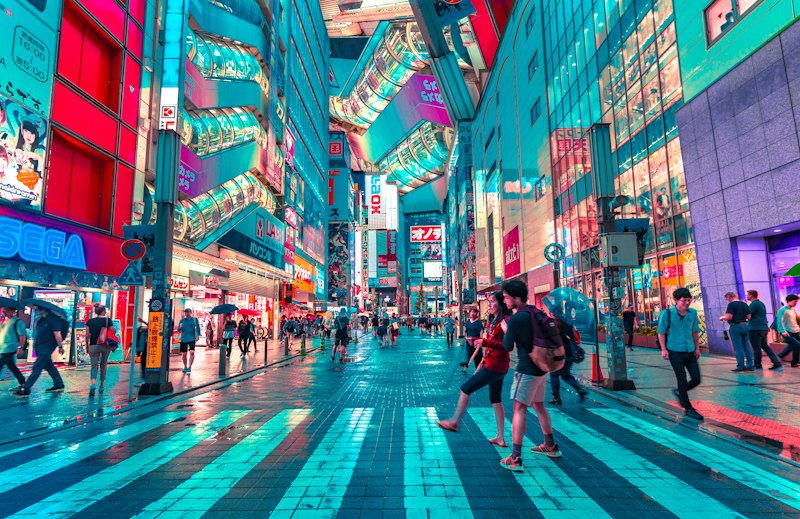
To ensure your visit to Shinsekai is as smooth and enjoyable as possible, keep these final practical considerations in mind.
Cash is King in Retro Osaka
While major shopping malls in Umeda and chain restaurants in Dotonbori widely accept credit cards, Apple Pay, and IC cards, Shinsekai remains proudly old-school. Many of the small, family-run kushikatsu shops, retro smart ball parlors, and independent cafes operate strictly on a cash-only basis.
- Actionable Advice: Ensure you withdraw plenty of Japanese Yen before entering the district. There are a few convenience stores (FamilyMart, Lawson) with international ATMs in the area, but having cash on hand is vital.
- Read more on this topic: Cash vs Card in Japan 2026: How Much Cash Do You Need?.
Safety and the Airin-chiku Context
Shinsekai is entirely safe during the day, bustling with tourists, families, and school trips. However, as an international traveler, it is important to have geographic context. Shinsekai is located immediately adjacent to the Nishinari Ward and the Airin-chiku (Kamagasaki) neighborhood, which is historically Japan's largest day-laborer district.
While Japan is extraordinarily safe by global standards, the area south of Shinsekai (particularly around Shin-Imamiya Station at night) is grittier than what tourists experience in Kyoto or Tokyo. You may encounter unhoused individuals or public drinking. There is no inherent danger to tourists, and violent crime is virtually nonexistent, but the atmosphere can be surprising if you are only used to the pristine streets of Ginza.
- Actionable Advice: Stick to the well-lit main streets of Shinsekai and Janjan Yokocho at night. The district usually winds down earlier than Dotonbori anyway, with many kushikatsu shops closing between 21:00 and 22:30.
The Best Time to Photograph Tsutenkaku
To get the most iconic photograph of Tsutenkaku Tower—the one framed by massive, colorful store signs and giant blowfish lanterns—you need to stand on the main southern approach street.
- Location: Walk south from the base of the tower towards the giant Kushikatsu Daruma sign. Turn around and face north. This specific angle aligns the extravagant restaurant facades perfectly with the towering steel structure behind them.
- Timing: The absolute best time for photography is the "blue hour" (just after sunset). The sky turns a deep indigo, and the neon lights of both the street and the tower (which uses LED lights to display a weather forecast!) glow brilliantly without blowing out the exposure on your camera.
Final Thoughts for Your 2026 Osaka Itinerary
Tsutenkaku Tower and the Shinsekai district are not polished. They are not quiet. They are loud, deeply fried, covered in neon, and utterly unforgettable.
By utilizing this updated 2026 guide, you can navigate the new admission prices (Adult ¥1,500 / Child ¥800 standard; ¥1,800/¥900 peak) and updated operating hours (9:00–21:45) of the tower with confidence. You now know exactly how to avoid budget pitfalls with the add-on attractions, how to respect the sacred rule of the kushikatsu sauce tin, and how to access the best historical eateries the district has to offer.
Whether you are here to rub the worn feet of the Billiken statue for good luck, play a ¥100 game of analog smart ball, or simply eat your weight in golden, crispy beef skewers, Shinsekai promises an authentic slice of Showa-era Japan that refuses to fade away. Enjoy the New World.
FAQ
Q: What are the 2026 admission prices for Tsutenkaku Tower?
For 2026, standard admission to the general observation deck is 1,500 yen for adults (15 and up) and 800 yen for children (5-14). Peak holiday pricing from December 30, 2026, to January 3, 2027, is 1,800 yen for adults and 900 yen for children.
Q: What are the operating hours for Tsutenkaku Tower in 2026?
The main observation deck is open from 9:00 AM to 9:45 PM, with the last admission at 9:15 PM. Add-on attraction hours like the TOWER SLIDER and DIVE&WALK may vary and should be checked on the official website.
Q: What is the golden rule for eating kushikatsu in Shinsekai?
The most critical rule is no double dipping (Nido-zuke Kinshi). You must submerge your skewer into the communal sauce tin only once before taking a bite to maintain hygiene. If you need more sauce, use the complimentary cabbage to scoop it.
Q: How do I get to Shinsekai from Umeda or Osaka Station?
Take the Midosuji Subway Line southbound from Umeda Station to Dobutsuen-mae Station. The ride takes about 12 minutes and costs 240 yen. Use Exit 1 to walk straight into the Janjan Yokocho arcade.
Q: Do I need to pay an entry fee to explore the Shinsekai district?
No, Shinsekai is a freely walkable public street district with no admission gates or entry fees. You only pay for food, shopping, and specific attractions like the Tsutenkaku observation deck.
Q: Should I bring cash when visiting Shinsekai?
Yes, cash is highly recommended in retro Osaka. While major chains may accept cards, many small, family-run kushikatsu shops, retro smart ball parlors, and independent cafes in Shinsekai are strictly cash-only.