[Disclosure] This article contains affiliate links. We may earn a commission at no extra cost to you.
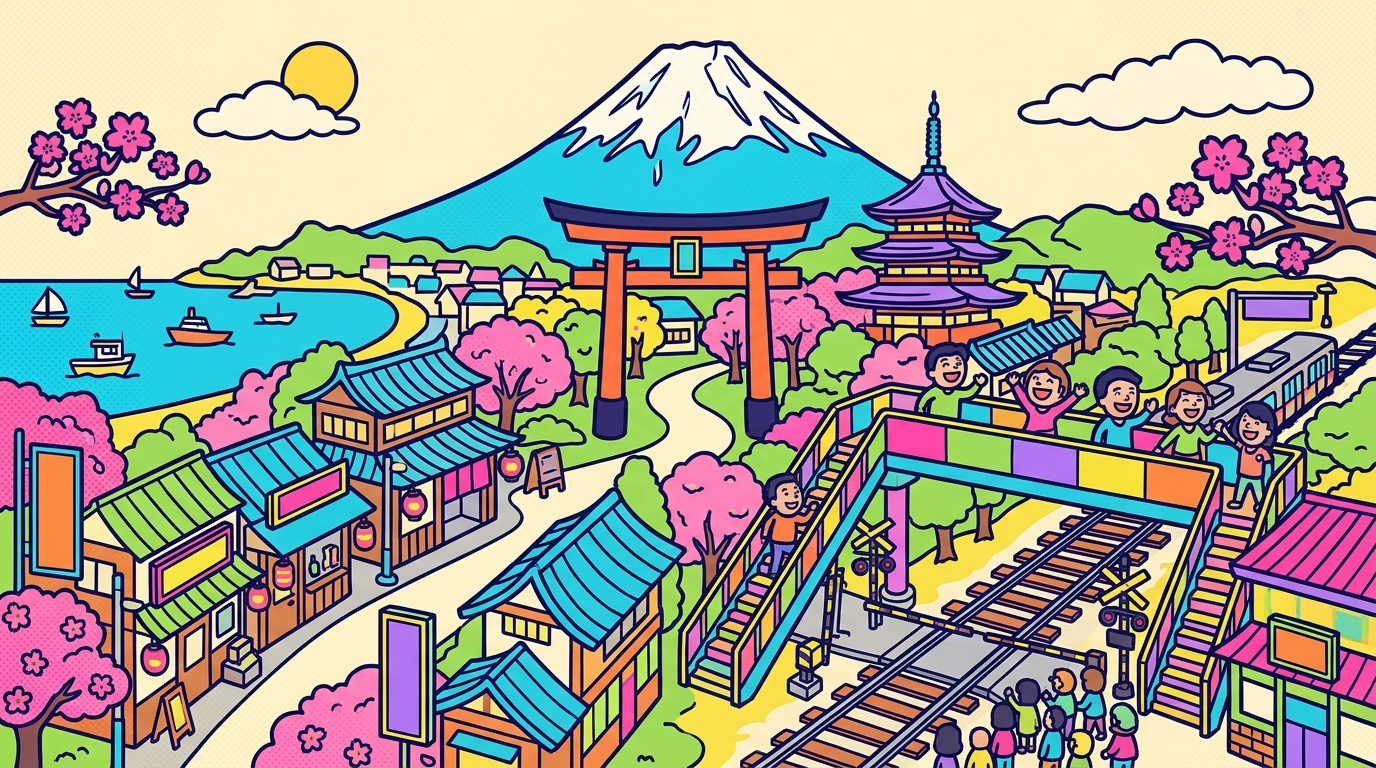
If you have scrolled through Instagram or TikTok anytime in the last five years, you already know about the Kamakurakoko-Mae railroad crossing. Made globally famous by the anime Slam Dunk, this tiny coastal intersection is now ground zero for overtourism in Japan. In 2026, you will find hundreds of tourists spilling into traffic, aggressive security guards with megaphones, and local drivers losing their minds. It is stressful, dangerous, and entirely skippable.
So, what is the alternative? This guide is your definitive blueprint for a 2026 Enoshima Island day trip that bypasses the Enoden (Enoshima Electric Railway) mob entirely. You should care because your vacation time is too valuable to spend shoulder-to-shoulder at a railway crossing. By following our local approach, you will learn exactly how to utilize alternative transport like the Shonan Monorail, discover hidden cliffside dining spots where you can actually get a seat, and secure better ocean views without fighting a crowd of influencers. We are giving you the unvarnished reality of Enoshima in 2026.
What You'll Get From This Guide
The "Flying Train" Secret: How to use the Shonan Monorail to skip the Enoden line entirely.
Real 2026 Financials: Exact transport, food, and entry costs in ¥ and USD.
Honest Food Advice: Why waiting at Tobiccho is a rookie mistake, and where locals eat shirasu instead.
The Geography Check: Why the tourist passes might actually waste your money depending on your route.
Better Photo Spots: Coastal vantage points that rival the Slam Dunk crossing but have zero crowds.
The Overrated Trap: Why Kamakurakoko-Mae is a Nightmare in 2026
It is time for some honesty: the Kamakurakoko-Mae railroad crossing is the biggest tourist trap in Kanagawa Prefecture.
The Overtourism Reality
Tourists commonly get this wrong: they believe they can just hop off the Enoden train at 1:00 PM, snap a serene photo of the ocean behind the train tracks, and continue their day. In late 2026, local authorities have put up massive warning signs, fenced off certain angles, and deployed traffic control due to tourists literally standing on active roads to get the shot.
If you are basing your day trip around this one crossing, you are setting yourself up for disappointment. You will wait 20 minutes to board a severely overcrowded Enoden train (which lacks air conditioning efficiency when packed like a sardine can), only to be yelled at by security when you arrive. Skip it.
Route 1: The Shonan Monorail (The Local’s Alternative)
If you still want to approach Enoshima from the Kamakura side, completely ignore the Enoden line. The local tip that contradicts every standard tourist brochure is to ride the Shonan Monorail.
How to Take It from Ofuna Station
Instead of going to Kamakura Station, take the JR Shonan-Shinjuku Line or Tokaido Line to Ofuna Station. From there, follow the signs for the Shonan Monorail. This is an inverted, suspended monorail—meaning the track is above the train. It flies over the suburban hills of Kamakura like a mild rollercoaster, offering fantastic views of Mount Fuji on clear days.
Price & Time Breakdown
The ride from Ofuna Station to Shonan-Enoshima Station takes exactly 14 minutes and costs ¥320 (~$2.13 USD) one way. From Shonan-Enoshima Station, it is a flat, easy 10-minute walk across the bridge to Enoshima Island itself.
Route 2: Exploring Enoshima Island directly from Shinjuku
The absolute most efficient way to do an Enoshima day trip if you don't care about Kamakura's temples is to head straight to the island.
Getting There via Odakyu Line
Head to Shinjuku Station and locate the Odakyu Line. You want to board a Rapid Express bound for Fujisawa, then transfer to a local train terminating at Katase-Enoshima Station. This station is impossible to miss—it is designed to look like a red underwater dragon palace.
The fare is ¥650 (~$4.33 USD) and takes roughly 65-75 minutes.
The Escalator Cheat Code
Once you cross the弁天橋 (Benten Bridge) onto Enoshima Island, you will face a steep mountain path leading up to Enoshima Shrine. Do not hike this in the afternoon heat or heavy rain. Immediately to your left after the red torii gate, buy an Enoshima Escar ticket. For ¥360 (~$2.40 USD), this series of three escalators takes you directly up to the 59.8-meter-tall Enoshima Sea Candle (entry: ¥700 / ~$4.66 USD). Your knees will thank you.
(Preparing for the intense sun on the open coast or the unpredictable rain? Before you go, pick up cheap and reliable Amazon Japan gear like a compact folding umbrella to stash in your daybag).
Honest Food Guide: Where to Eat Shirasu-don
Enoshima is synonymous with shirasu (whitebait).
Skipping the Main Street Lines
The most famous restaurant on the island is Tobiccho. Tourist guides will tell you this is a "must-visit." It is completely overrated. By 11:30 AM, Tobiccho’s digital queue machine will hand you a ticket with a 90-to-120-minute wait time. Do not waste two hours of your day trip sitting on a plastic chair in front of a restaurant.
A Better Alternative: Uomitei
Instead, walk to the absolute back of the island toward the Iwaya Caves. Perched on the cliffside is Uomitei (魚見亭). Because it requires walking up and over the island's peak, lazy tourists skip it.
Walk in, ask for terrace seating, and you will eat suspended over the Pacific Ocean. A massive bowl of half-and-half shirasu-don (raw and boiled whitebait) costs ¥1,450 ($9.66 USD), and an ice-cold draft beer is ¥650 ($4.33 USD). The view is ten times better than Tobiccho, and the wait is a fraction of the time.
If you want those nostalgic Japanese coastal photos without fighting for your life at Kamakurakoko-Mae, there are vastly superior alternatives.
Shichirigahama & Inamuragasaki
If you absolutely must ride the Enoden for the aesthetic, get off at Inamuragasaki Station instead. Walk 5 minutes to Inamuragasaki Park. It offers a sweeping view of the dark sand beach, Enoshima Island in the distance, and Mount Fuji right behind it. There are no traffic guards here—just local surfers and dog walkers.
Hidden Photo Spots Comparison
Location
Famous For
2026 Crowd Level
Best Photo Subject
Kamakurakoko-Mae
Slam Dunk Crossing
Unbearable
Train passing ocean
Inamuragasaki Park
Surfer Vibe
Very Low
Enoshima + Mt. Fuji
Shichirigahama Beach
Seaside Cafes
Moderate
Coastal waves + Train tracks
Chigogafuchi (Enoshima)
Rocky Abyss
Low
Sunset over the Pacific
Frequently Asked Questions
Q: How much does an Enoshima day trip from Tokyo cost in 2026?
A day trip to Enoshima remains one of the most budget-friendly escapes from Tokyo, provided you manage your transport wisely. Assuming you depart from Shinjuku Station via the Odakyu Line, your base round-trip train fare to Katase-Enoshima Station will be exactly ¥1,300 ($8.66 USD) using a standard Suica or Pasmo IC card. Once on the island, you will likely purchase the Enoshima Escar ticket (escalator) for ¥360 ($2.40 USD) and entry to the Enoshima Sea Candle observation tower for ¥700 ($4.66 USD). For lunch, a premium half-and-half Shirasu-don (boiled and raw whitebait bowl) will run you around ¥1,500 ($10.00 USD) at most local restaurants. If you add a craft beer, a matcha ice cream on Nakamise Street (¥450 / $3.00 USD), and round-trip transport, expect your baseline 2026 total to hover safely around ¥4,500 to ¥5,500 ($30.00 to $36.66 USD) per person. This makes it significantly cheaper than modern theme parks.
Q: Is the Enoshima-Kamakura Freepass actually worth it if I skip the crowded Enoden?
The short answer is no, it is absolutely not worth it if you follow this guide's advice. The Odakyu Enoshima-Kamakura Freepass currently costs ¥1,640 (~$10.93 USD) from Shinjuku. It includes your round-trip journey to Fujisawa Station, plus unlimited rides on the Enoden train line. However, because the core premise of our 2026 strategy is to skip the heavily congested Enoden railway and avoid the Kamakurakoko-Mae crossing trap, buying this pass means you are paying for transport you will not use. Instead, simply tapping your IC card from Shinjuku to Katase-Enoshima costs ¥650 each way (¥1,300 total / $8.66 USD). By paying à la carte, you instantly save ¥340 ($2.26 USD)—which is enough to buy a fresh grilled seafood skewer on the island's main approach. Unless you plan to endure the packed Enoden to visit the Great Buddha in Kamakura on the exact same day, skip the pass entirely.
Q: Is the local raw shirasu (whitebait) safe for foreign tourists to eat?
Yes, it is entirely safe, but there is a strict freshness window that local vendors adhere to rigorously. Raw shirasu (namashirasu) is a regional delicacy of the Shonan coast, but it spoils incredibly fast. In 2026, local fishing cooperatives maintain a rule: if the boats cannot go out due to bad weather or rough waves, restaurants will simply cross the raw shirasu off their menus for the day. They do not serve day-old raw whitebait. If you see it on the menu, it means it was caught that very morning. The texture is gelatinous with a slight crunch, and it carries a subtle, briny flavor of the ocean with a hint of bitterness. If you are prone to stomach issues or simply dislike slimy textures, you should opt for the kama-age shirasu (boiled whitebait), which is fluffy, savory, and equally traditional. Most restaurants offer a "half-and-half" bowl so you can safely try both styles.
Q: What is the best time and place to see Mount Fuji from Enoshima in 2026?
If you want the iconic, unobstructed view of Mount Fuji floating behind the ocean, your timing is critical. During the humid summer months, Fuji is almost permanently hidden behind haze, even on sunny days. However, from November through February, the cold, crisp winter air provides crystal-clear visibility. To maximize your chances in late 2026, you need to arrive at Enoshima either very early in the morning (before 10:00 AM) or right at golden hour (around 4:00 PM to 4:30 PM). The absolute best vantage point is Chigogafuchi Abyss, the rocky coastal plateau located at the very back of Enoshima Island behind the Iwaya Caves. Alternatively, the outdoor deck of the Enoshima Sea Candle offers a 360-degree panorama. Do not bother trying to photograph Fuji from the mainland Kamakura beaches during midday; the midday sun glares off the water, washing out the mountain completely.
Q: Is Enoshima Island accessible for solo travelers with strollers or mobility issues?
This is a hard truth about Enoshima: it is essentially a steep mountain rising out of the sea, and it is notoriously unfriendly to wheels. While the Enoshima Escar (a series of three paid escalators costing ¥360 / ~$2.40 USD) will conveniently carry you UP to the Samuel Cocking Garden and Sea Candle, there are zero escalators going DOWN. The descent requires navigating hundreds of steep, uneven stone steps. Furthermore, if you wish to visit the Iwaya Caves or the Chigogafuchi rock pools at the back of the island, you must descend a massive outdoor staircase that you will later have to climb back up. If you are traveling in a wheelchair, your access is strictly limited to the Nakamise shopping street at the base of the island and the yacht harbor area. For families with infants, leave the heavy stroller at the train station lockers and use a wearable baby carrier instead.
Bottom Line
An Enoshima day trip in 2026 is phenomenal, provided you stop copying the same tired itineraries from five years ago. By ditching the overhyped Kamakurakoko-Mae crossing and embracing alternative transit like the Shonan Monorail, you preserve your sanity and discover a much more authentic side of the Shonan coast. This trip is NOT for travelers expecting a fully flat, modernized resort—you will sweat, you will climb stairs, and you will walk heavily. If you prefer to stay in the city, Search best hotels in Japan on Booking.com and enjoy Tokyo; but if you want raw ocean beauty and fresh seafood without the tourist-trap hassle, do Enoshima our way.