[PR] This article contains affiliate links.
It's the traveler's nightmare scenario. You're halfway through your dream Japan trip, laden with unique souvenirs, when it happens. A catastrophic wheel failure. A zipper that gives up the ghost. A crack in the hardshell after a rough encounter with baggage handlers. Your trusty suitcase is now a giant, unwieldy piece of junk. Your immediate thought is, "What on earth do I do with this now?"
In most countries, you might find a large dumpster. In Japan, that simple solution does not exist. The country's legendary cleanliness is upheld by a complex and strictly enforced system of waste disposal. For a tourist, navigating this system can feel more daunting than deciphering the Tokyo subway map during rush hour.
Fear not. This is your definitive, exhaustive guide to legally and responsibly disposing of a broken suitcase in Japan. We'll cover the easy hotel options, the clever retail strategies, the airport's last-minute solutions, and the critical rules you must follow to avoid massive fines and show respect for local customs. Forget the panic; let's get this sorted.
The Golden Rule: Absolutely No Illegal Dumping (不法投棄, Fuhō Tōki)
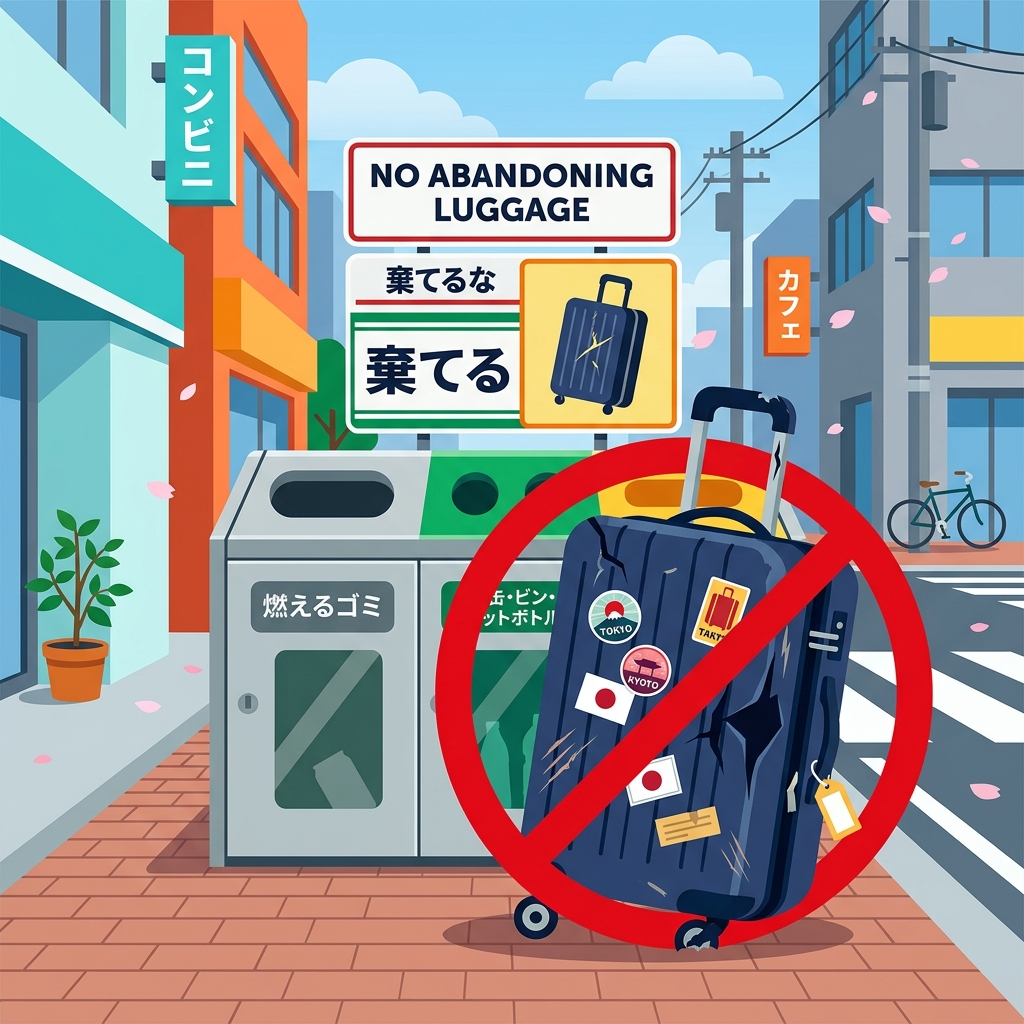
Before we explore the solutions, let's address the most critical point: Do not, under any circumstances, illegally dump your suitcase.
It might be tempting to just leave it by a public trash can, shove it behind a vending machine, or abandon it in a quiet alley. This is a terrible idea in Japan for several reasons:
- It's a Serious Crime: Illegal dumping, known as fuhō tōki (不法投棄), is not a minor infraction. It's a criminal offense. The penalties are severe, with fines of up to ¥10 million (approximately $65,000 USD) and potential prison sentences of up to five years. While a tourist is unlikely to face the maximum penalty, significant fines and serious legal trouble are a very real possibility.
- You Will Be Found: Japan has an astonishing number of security cameras. From convenience stores to train stations to residential streets, your actions are likely being recorded. The idea of "no one will see" is a dangerous fantasy.
- It's Deeply Disrespectful: Japanese society places a high value on community, cleanliness, and following rules. Leaving your large trash for someone else to deal with is considered incredibly rude and reflects poorly on all tourists.
In short, the convenience is not worth the risk. The following legal methods are straightforward and will ensure your trip continues smoothly.
Option 1: The Tourist's Best Friend - Ask Your Hotel Concierge
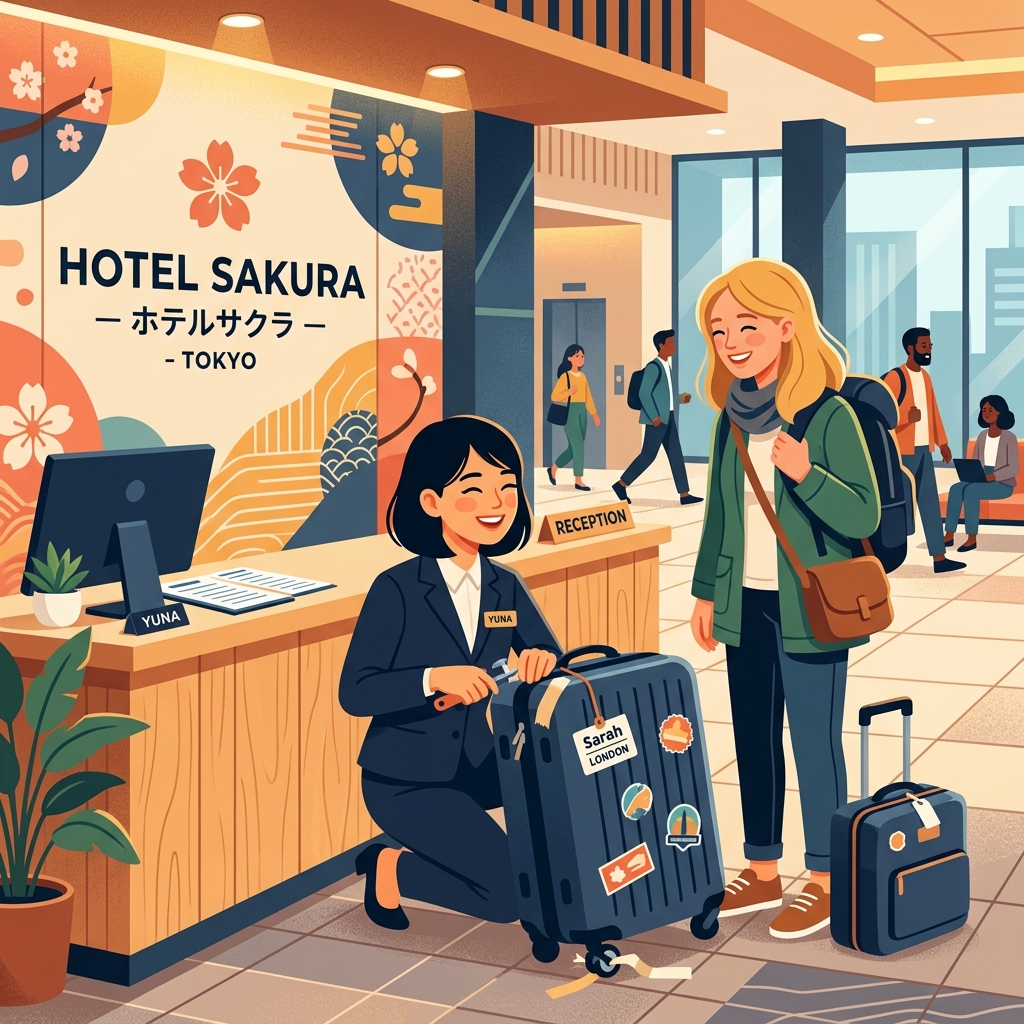
This is, by far, the simplest, most efficient, and highly recommended method for any tourist staying in a hotel. Hotels are accustomed to dealing with international guests and their various needs, including the occasional luggage mishap.
How It Works
Nearly all mid-range to high-end hotels offer a paid disposal service for oversized items like a broken suitcase. The process is incredibly simple:
- Empty Your Suitcase: Make sure you've removed all your belongings.
- Go to the Front Desk: Take the empty suitcase to the front desk or concierge.
- Ask for Disposal: Use a simple phrase to make your request.
- Pay the Fee: They will inform you of the fee, which is typically added to your final hotel bill.
What to Say
While most hotel staff in major cities speak some English, knowing a few key phrases can make the interaction smoother.
- Simple English: "Hello, my suitcase is broken. Could you please help me dispose of it?"
- Polite Japanese: "Sumimasen. Kono sūtsukēsu ga kowaremashita. Shobun o onegai dekimasu ka?" (すみません。このスーツケースが壊れました。処分をお願いできますか?) - "Excuse me. This suitcase is broken. Could I please ask you to dispose of it?"
- If they ask about a fee: "Hai, daijōbu desu." (はい、大丈夫です。) - "Yes, that's fine."
Expected Fees (as of 2026)
The fee is not arbitrary; it's what the hotel has to pay the municipal government or their private waste contractor to dispose of "oversized garbage" (sodai gomi). The price varies by the suitcase's size and the city's specific regulations.
- Carry-on size: Expect to pay between ¥500 - ¥1,500.
- Medium to Large size: Expect to pay between ¥1,500 - ¥3,000.
- Extra-Large/Trunk size: Fees could potentially reach ¥4,000.
Some luxury 5-star hotels may offer this service as a complimentary courtesy, but you should always assume there will be a fee. The convenience is well worth the cost. Having some extra yen on hand is always a good idea; check out our guide on how much cash you should bring to Japan.
Important Considerations:
- Business Hotels & Budget Chains (APA, Toyoko Inn, etc.): These hotels almost always offer this service, but it will always come with a fee.
- Ryokans: Traditional Japanese inns may or may not offer this service. Smaller, family-run ryokans might not have a system in place. It's best to ask. If you're staying in a beautiful ryokan, perhaps one of the best ryokan for summer, be extra polite when you ask.
- Hostels & Guesthouses: This can be hit-or-miss. They have fewer resources than large hotels. Ask the staff, but have a backup plan.
- Airbnb: This is the most difficult situation. Your host is a private individual, not a corporation. They are subject to the same complicated sodai gomi rules as any other resident. They cannot simply "throw it away" for you. While you can message them and ask for advice, do not expect them to handle it. You will likely need to use one of the other options below.
Option 2: The "Upgrade & Dispose" - Retail Store Services
This is your second-best option and the go-to solution if your hotel can't help or if you were planning on buying a new suitcase anyway. Many large retailers that sell luggage will take your old, broken one off your hands when you purchase a new one from them.
This service is called hikitori (引き取り), meaning "take-back."
How It Works
The policy varies from store to store, but the general flow is:
- Bring your empty broken suitcase to the store.
- Choose your new suitcase.
- At the checkout counter, inform the staff you'd like them to dispose of your old one.
- They will either do it for free or charge a small service fee.
Key Phrase to Use
- "Atarashii sūtsukēsu o kōnyū shitai desu. Furui mono no hikitori sābisu wa arimasu ka?" (新しいスーツケースを購入したいです。古いものの引き取りサービスはありますか?) - "I want to buy a new suitcase. Do you have a take-back service for the old one?"
Top Stores for the "Upgrade & Dispose" Strategy
Here are specific, tourist-friendly locations where this strategy is most likely to succeed.
1. Don Quijote (ドン・キホーテ)
The legendary variety store is a tourist haven, known for its chaotic aisles, late hours, and tax-free shopping. They also have a massive selection of affordable luggage. Their take-back policy can be inconsistent and depends on the specific store manager, but the major tourist-centric locations are often willing to help a customer making a purchase.
- Best Bet: Don Quijote Shinjuku Tonanguchi Store
- Why here? It's enormous, open 24/7, and extremely accustomed to tourists. It's a prime candidate for helpful service. You can do all your last-minute souvenir shopping here, as detailed in our Don Quijote Shopping Guide.
- Expected Fee: Free to ¥1,000 with the purchase of a new suitcase.
- Access: A 5-minute walk from the South-East or East Exit of JR Shinjuku Station.
- Google Maps:
2. Bic Camera / Yodobashi Camera
These are Japan's two largest electronics and home goods megastores. They have extensive travel sections with a wide range of luggage, from budget to high-end brands like Samsonite and ACE. Their corporate structure means they often have more formalized take-back policies.
-
Best Bet (Yodobashi): Yodobashi Camera Multimedia Akiba
- Why here? This is the flagship store in the heart of Akihabara. The luggage section is huge. After you're done, you can grab a bite at one of the best restaurants in Akihabara.
- Expected Fee: Often free with the purchase of a new suitcase over a certain price (e.g., ¥10,000). Otherwise, expect a fee of around ¥500 - ¥1,500.
- Access: A 1-minute walk from the Showa-dori Exit of JR Akihabara Station.
- Google Maps:
-
Best Bet (Bic Camera): Bic Camera Shinjuku East Exit Store
- Why here? Directly connected to Shinjuku station, it's incredibly convenient. They have multiple buildings, so look for the one with travel goods (usually indicated on the store directory).
- Expected Fee: Similar to Yodobashi, often free with a qualifying purchase or a small fee.
- Access: A 1-minute walk from the East Exit of JR Shinjuku Station.
- Google Maps:
3. Tokyu Hands / LOFT
These are fantastic "lifestyle" department stores that sell everything from high-quality stationery to kitchenware and, of course, luggage. They tend to carry more stylish and well-regarded brands.
- Best Bet: Tokyu Hands Shinjuku Store
- Why here? Located within the Takashimaya Times Square complex, this multi-floor store is a destination in itself. Their travel section ("Go-Go Travel") is excellent.
- Expected Fee: They may have a formal program. Expect a fee of ¥1,000 - ¥2,000, or a discount on the service with a new purchase.
- Access: A 2-minute walk from the New South Gate of JR Shinjuku Station.
- Google Maps:
Option 3: The Last Resort - Airport Solutions
What if your suitcase gives out on your last day, as you're heading to the airport? Your options become more limited, but you're not out of luck. The key is to handle this before you check in and go through security.
At Narita (NRT) or Haneda (HND) Airport
Your primary strategy remains the same: buy a new suitcase and ask the store to take the old one. Major Japanese airports are like mini-shopping malls and have several stores selling luggage.
Step 1: Locate a Luggage Store
- Narita Airport (NRT): Look for stores like ACE, Samsonite, or general travel goods stores like Traveler's Factory and HI-CONDITION. They are located in the main shopping areas of Terminal 1 and Terminal 2 before security.
- Haneda Airport (HND): Head to the shopping areas in Terminal 3 (International). You'll find stores like Travel Pro-Tect and department store outposts that carry luggage.
Step 2: Use the "Upgrade & Dispose" Method
Approach the store staff and use the same phrases as in Option 2. Given their location, airport stores are very familiar with this exact problem and are usually helpful, provided you are making a purchase. The fee structure will be similar to high-street stores.
The Repair Alternative
If the damage is minor (a single broken wheel or a faulty handle), a repair might be cheaper and faster than a full replacement.
- Look for "Riat!" or "Mister Minit": These are common shoe and bag repair chains in Japan, and they have branches in the airports.
- At Narita (NRT): You can typically find a Riat! branch in the basement (B1F) levels of both Terminal 1 and Terminal 2.
- At Haneda (HND): Look for repair shops in the main departures hall shopping areas.
- Cost & Time: A simple wheel replacement might cost ¥3,000 - ¥5,000 and take about 60-90 minutes. This can be a trip-saver if you're short on time.
What You CANNOT Do at the Airport
- You cannot use airport trash cans. They are not equipped for oversized items, and leaving a suitcase next to one is still illegal dumping.
- There is no general "oversized garbage disposal" service. The airport information desk will direct you to the retail stores or repair shops.
- Once you are past security, your options are zero. Do not take a broken suitcase through security hoping to deal with it at the gate. You will have no choice but to check it in or abandon it (again, illegal).
Option 4: "Tourist Hard Mode" - The Municipal Sodai Gomi System
This section is for informational purposes and for the rare tourist on a long-stay visa who might have the time and language skills to attempt it. For 99% of tourists, this method is not practical. However, understanding it helps explain why Japan's rules are so different.
Sodai Gomi (粗大ゴミ) is the official category for oversized waste—generally anything with one side longer than 30cm. Every resident must follow this procedure to dispose of large items.
The Hurdles for a Tourist
- Requires a local address and phone number.
- The entire application process is in Japanese.
- You must make an appointment for pickup, which can be days or even weeks in the future.
- You must purchase specific disposal stickers that are only valid for the city ward you are in.
The Official Process (Abridged)
- Find the Sodai Gomi Center: You have to search online for the "粗大ゴミ受付センター" (Sodai Gomi Uketsuke Center) for your specific ward (e.g., Shinjuku-ku, Shibuya-ku).
- Make an Appointment: You call them (or sometimes use a Japanese-only web form). You tell them what you're disposing of (スーツケース, sūtsukēsu) and its approximate dimensions.
- Get a Price and Date: They will tell you the fee (e.g., ¥400 for a small one, ¥800 for a large one) and your scheduled pickup date and time (e.g., "by 8 AM on October 26th").
- Buy the Sticker: You go to a local convenience store (like 7-Eleven or FamilyMart) in that same ward and buy a "粗大ごみ処理券" (sodai gomi shori ken) for the exact amount they told you. You cannot use a sticker from another ward.
- Prepare for Pickup: You write your name or a confirmation number on the sticker, attach it prominently to the suitcase, and place it at the designated pickup spot (e.g., the entrance of your apartment building) on the morning of your scheduled date.
As you can see, this is a complex, multi-day process that is simply not feasible for a traveler on a tight schedule. Stick to Options 1 and 2.