[PR] This article contains affiliate links.
The small coastal town of Oarai in Ibaraki Prefecture rests on the Pacific Ocean, roughly two hours northeast of Tokyo. For decades, it was known primarily as a quaint seaside getaway favored by domestic travelers seeking summer surfing, winter monkfish hot pot, and the breathtaking coastal shrine gate that stands directly in the crashing waves. However, in March 2011, Oarai was struck by the devastating Tohoku earthquake and the ensuing tsunami. The waves inundated the port, battered local businesses, and severely damaged the town’s vital fishing and tourism industries.
Yet, if you walk the streets of Oarai today in 2026, you will find a thriving, bustling local economy. You will see young tourists and international visitors lining up outside local butchers, stationary shops, and tea houses. The catalyst for this astonishing recovery was not a massive government public works project or a sprawling corporate resort. It was a late-night animated television series about high school girls operating World War II-era tanks.
The anime Girls und Panzer (2012–2013) explicitly featured Oarai as its primary real-world setting. In the years since its broadcast, the collaboration between the anime’s production committee, the town’s local government, and the citizens of Oarai has become one of the most widely studied cases of "anime pilgrimage" (or seichi junrei) tourism in Japan. It is a masterclass in how pop culture can directly contribute to a town's post-disaster economic revival.
This exhaustive, comprehensive guide will take you deep into the heart of Oarai. Whether you are a die-hard fan of the franchise looking to retrace the tracks of your favorite characters, or a general traveler interested in the fascinating intersection of modern anime tourism, academic urban revival, and traditional Japanese coastal culture, this 2026 guide will provide you with everything you need to know.
The Academic Miracle of Oarai: How Anime Revived a Town
Before we dive into the specific shops, shrines, and transit routes, it is vital to understand just how unprecedented Oarai’s success story is. Anime tourism is common in Japan, but the economic and demographic impact on Oarai has transcended fandom to become a subject of serious scholarly research.
If you are new to the concept of visiting real-world anime locations, we highly recommend reading our Anime Pilgrimage in Japan: A Beginner guide and our Anime Pilgrimage Kanto Region Guide 2026 for broader context. But Oarai is in a league of its own.
The Post-Tsunami Context
When the 2011 tsunami hit, Oarai's coastal infrastructure was devastated. While the town did not suffer the catastrophic loss of life seen further north in Miyagi and Fukushima prefectures, the economic engine of the town ground to a halt. Tourism numbers plummeted, and local shops faced the grim prospect of permanent closure.
In 2012, a new original anime production called Girls und Panzer began airing. Directed by Tsutomu Mizushima, the show juxtaposed a highly accurate depiction of historical tanks with a traditional sports-underdog narrative, set almost entirely against the meticulously recreated backdrop of Oarai.
The Town Embraces the Phenomenon
Unlike many municipalities that react sluggishly to sudden internet fame, Oarai moved with astonishing speed. A University of Tsukuba research study documents that the Oarai Chamber of Commerce formally adopted the anime as an official tourism resource starting in 2012, the very year after the first season aired. The town did not just tolerate the influx of fans; they welcomed them as partners in the town's revival.
The results were statistically staggering. A 2017 academic paper from ITU Japan (a telecommunications industry research journal) ranked Oarai as the #1 anime pilgrimage site in Japan by visitor volume among the top ten sites it tracked.
The economic boom culminated in massive events. A 2013 town tank-and-anime-themed festival event drew approximately 32,000 attendees, roughly 5 times the turnout of the comparable event the year before. The phenomenon is so well-documented that there is a dedicated KAKEN (Japan Society for the Promotion of Science)-funded academic research project specifically studying Oarai's "content tourism" phenomenon. This underscores that Oarai is one of the most seriously documented anime-tourism case studies in Japan, proving that its success is based on measurable socioeconomic data, not just fan claims.
Furthermore, the connection has run so deep that it has actually impacted the town's demographics. A local town official has been quoted estimating that 100+ new residents moved to Oarai specifically because of the show's influence and fandom—a massive achievement for a rural Japanese town combating national trends of rural depopulation.
What is Girls und Panzer? A Brief Primer for Non-Fans
If you are visiting Oarai simply to witness this fascinating cultural phenomenon, you might be wondering what the anime is actually about.
Girls und Panzer (often abbreviated as Garupan) takes place in an alternate universe where a sport called "Sensha-do" (the way of the tank, or "tankery") is a traditional martial art for young women, much like kendo or flower arrangement. The protagonist, Miho Nishizumi, transfers to Oarai Girls' Academy, a school located on an enormous, city-sized aircraft carrier that docks in the real-world port of Oarai.
The girls must revive the school's defunct Sensha-do program and win the national tournament to save their school from closure. To do so, they drive incredibly accurate, meticulously researched World War II-era tanks (such as the Panzer IV, the Churchill, and the M4 Sherman).
What makes the anime so vital to the town is its geographic accuracy. During the show's battles—particularly a memorable exhibition match—the tanks literally drive through the real streets of Oarai. They pass by actual shopfronts, crash into the real local hotel, and navigate real intersections. For fans, visiting Oarai is not just about seeing an "inspiration" for a setting; it is about standing in the exact 1:1 locations where the animated action took place.
How to Get to Oarai from Tokyo in 2026: A Step-by-Step Transit Guide
Despite its rural charm, Oarai is highly accessible from central Tokyo, making it an excellent day trip or overnight excursion.
Step 1: Tokyo to Mito Station (JR Joban Line)
Your journey begins by heading to either Tokyo Station or Ueno Station to catch the JR Joban Line.
- The Fastest Route: Take the Hitachi or Tokiwa Limited Express trains. These sleek, comfortable trains take about 75 minutes to reach Mito Station, the capital city of Ibaraki Prefecture.
- Cost: Approximately 3,890 JPY (Base fare + Limited Express ticket). This route is fully covered by the JR Pass or the JR Tokyo Wide Pass.
- The Local Route: If you want to save money, you can take a regular local Joban Line train. It takes roughly 2 hours but costs only 2,310 JPY.
Step 2: Mito Station to Oarai Station (Kashima Rinkai Railway)
At Mito Station, you will transfer to the local, non-JR Kashima Rinkai Railway (Oarai-Kashima Line).
- Follow the signs in Mito Station for the Kashima Rinkai Railway (usually platforms 8/9).
- Cost: 330 JPY.
- Time: About 15 minutes.
- Important Transit Note for 2026: While major networks accept IC cards, regional lines can sometimes have unique rules. If you are wondering about how to manage payment on local lines, check out our guide: What is the Best IC Card for Tourists in Japan 2026? | Suica vs Pasmo vs ICOCA. Also, bringing some cash is always recommended in rural areas, as detailed in our Cash vs Card in Japan 2026: How Much Cash Do You Need? guide.
The Wrapped Trains
The Kashima Rinkai Railway has been a core partner in the anime collaboration. For years, the railway has run character-liveried (wrapped) trains as part of the official tie-in. These trains feature vibrant artwork of the characters on the exterior and often include special interior advertisements or voice announcements by the voice actors. Because these are long-running features, be sure to check the current operating status and timetable for the wrapped trains on the Kashima Rinkai Railway’s official website before you visit, as the specific liveries are periodically refreshed.
Core Pilgrimage Spots: The Essential Oarai Itinerary
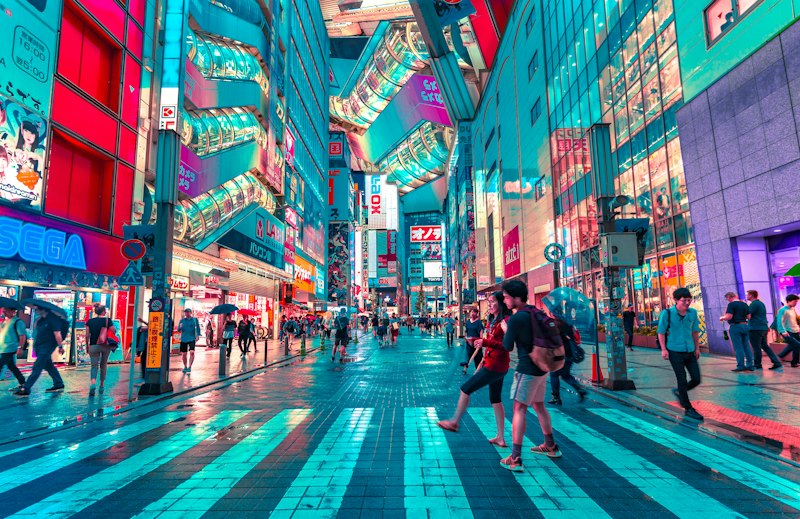
The beauty of Oarai is that the entire town is the pilgrimage site. Character artwork and full-size cardboard panels are displayed town-wide in Oarai—inside shops, at the torii gate at Kamiiso shrine, and at train stations. This is an ongoing, long-term, town-tourism-board-endorsed fixture, not a time-limited pop-up campaign.
Below are the most critical locations to visit, complete with access information and Google Maps embeds so you can build your itinerary.
1. Oarai Station & Tourist Information Center
Your pilgrimage literally begins the moment you step off the train. Oarai Station is heavily decorated with Girls und Panzer banners, posters, and welcoming signs.
Inside the station building, you will find a dedicated Tourist Information Center. This is your most important first stop. The center features a massive array of character panels, autographed posters from the cast and crew, and display cases full of rare merchandise. Most importantly, you can pick up physical "Pilgrimage Maps" (Seichi Junrei Maps) printed by the town. These maps precisely pinpoint where every character panel is located across the hundreds of participating local businesses.
- Admission: Free.
- Hours: Station is open from early morning to late evening; Info Center typically 9:00 AM – 5:00 PM.
- Access: The terminus of your arrival via the Kashima Rinkai Railway.
2. Oarai Isosaki Shrine (and the Kamiiso-no-Torii)
Oarai Isosaki Shrine is the historical and spiritual heart of the town, predating the anime by over a millennium (founded in 856 AD). The shrine sits on a hill overlooking the Pacific Ocean.
In the anime, the shrine's steep stone staircases and forested paths are featured prominently. However, what makes the shrine a must-visit for anime tourists is the ema (wooden votive plaques) hanging rack. Fans from all over the world purchase blank ema from the shrine maidens and draw astonishingly detailed, museum-quality illustrations of the anime characters on them, leaving them as offerings. The shrine officially embraces this, even selling their own anime-collaboration ema and protective amulets.
Furthermore, independent of the anime, the shrine is famous for the Kamiiso-no-Torii, a magnificent stone gate standing on a rocky reef directly in the crashing waves of the Pacific Ocean. It is considered one of the most beautiful sunrise spots in all of Japan.
- Admission: Free to enter the shrine grounds.
- Hours: Grounds open 24/7. Shrine office (for amulets/ema) usually 8:30 AM – 4:30 PM.
- Access: About a 10-minute taxi ride or a 35-minute walk from Oarai Station. There is also a local loop bus (Kaiyu-go) that stops near the shrine.
3. Oarai Marine Tower
Standing 60 meters tall near the port, the Oarai Marine Tower is the town's most visible landmark. The tower offers a panoramic observation deck where you can look out over the Pacific Ocean, see the expanse of Oarai, and on clear days, even spot Mount Fuji.
The tower is a recurring visual anchor in the anime. Inside, the collaboration is deeply woven into the facility. The second floor features the Panzer-Vor cafe, an officially licensed Girls und Panzer themed cafe where you can eat tank-shaped food, drink themed beverages, and sit at tables decorated with the school crests. (Always check current operational hours as cafe schedules can vary seasonally).
- Admission (Observation Deck): 340 JPY for adults.
- Hours: 9:00 AM – 6:00 PM (March to October), 9:00 AM – 5:00 PM (November to February).
- Access: A 15-minute walk from Oarai Station, located right on the waterfront.
4. Oarai Seaside Station & The Garupan Gallery
Oarai Seaside Station is an open-air shopping complex located near the Marine Tower. (It was formerly known as the Oarai Resort Outlets). In the anime, the tanks hide and maneuver through the open-air corridors of this very mall during a critical battle sequence.
The most important stop here for fans is the Oarai Garupan Gallery. This is the ultimate dedicated merchandise and exhibition space for the franchise in town. It operates almost like a museum, featuring production materials, limited-edition town-only merchandise, apparel, and a rotating exhibition of fan-donated items. If you are looking to buy souvenirs that prove you made the pilgrimage, this is the place to do it.
- Admission: Free to enter the mall and the gallery.
- Hours: Mall hours vary, but the gallery is generally open 10:00 AM – 7:00 PM.
- Access: Adjacent to the Marine Tower; a 15-minute walk from Oarai Station.
5. Oarai Hotel
The Oarai Hotel is a premier beachfront resort, but it holds a special, somewhat comedic place in the hearts of fans. During the anime's town battle, one of the tanks accidentally fires a shell directly into the façade of the Oarai Hotel, causing a massive explosion.
Rather than taking offense at their property being "destroyed" on television, the real-world Oarai Hotel embraced it completely. For years, they would literally hang a massive tarp over the side of the building painted to look like blast damage. They host collaboration accommodation plans where guests receive exclusive anime amenities, towels, and folders. Even if you don't stay overnight, walking past the hotel to see the real-life location of the famous "blast" is highly recommended.
- Cost: Room rates vary widely by season, typically 20,000 to 40,000 JPY per night including half-board (dinner and breakfast).
- Access: Located along the coast, about a 5-minute walk south of Oarai Isosaki Shrine.
The "Garupan" Street: Local Shops and Fan Hospitality
While the major tourist spots above are fantastic, the true soul of the Oarai pilgrimage lies in the local shopping streets (specifically the Higashi-machi and Magari-matsu shopping districts).
When the Chamber of Commerce adopted the anime in 2012, they initiated the character panel project. Almost every shop along the main street was assigned a specific character from the anime. A life-size cardboard cutout of that character was placed in the shop window or right on the street.
What happened next is the magic of Oarai. The shopkeepers—many of whom were elderly residents who had never watched a late-night anime before—adopted their assigned characters as if they were their own grandchildren. They decorated their shops with fan gifts, created special character-themed menu items, and learned the lore of the show so they could converse with visiting fans.
Here are a few standout shops that are a must-visit. (Note: These are small, independent family businesses. Hours can be irregular, and they may close on random weekdays. Always bring cash).
Takahashi Mitsudango
A small, humble sweets shop that features the character panel of Hana Isuzu. They sell a local Oarai specialty called mitsudango—skewered wheat-flour dumplings covered in a sweet, sticky soy glaze and dusted with kinako (roasted soybean flour). It is incredibly cheap (often around 100 to 150 JPY per stick) and absolutely delicious. The interior of the shop is plastered with fan art.
- Access: Located in the Magari-matsu shopping street area, roughly 15 minutes walking from the station.
Usui Meat Shop (Usuya)
A local butcher shop that became incredibly famous among fans. They host the panel of the character Yuzu Koyama. Rather than just selling raw meat, they cater to walking tourists by frying up hot, fresh kushikatsu (deep-fried meat and onion skewers) right in the front window. Grabbing a skewer for about 200 JPY and eating it on the bench outside while chatting with the friendly owners is a quintessential Oarai experience. They even have a dedicated rest area inside for fans to sit, read manga, and write in the shop's guestbook.
- Access: Located along the main shopping street near the center of town.
Yamaguchiya Pharmacy
Even places that don't sell food are part of the fun. Local pharmacies, hardware stores, and liquor shops all participate. Yamaguchiya is famous for hosting the character panel of the eccentric history buff character, Erwin. The pharmacy owners have fully leaned into the military history theme, and the shop is a treasure trove of character goods and fan-made displays, despite primarily being a place to buy aspirin and bandages!