🔍Checked against official sources and updated regularly by a JAPHIC-certified operator. About us →
⚡ Quick facts
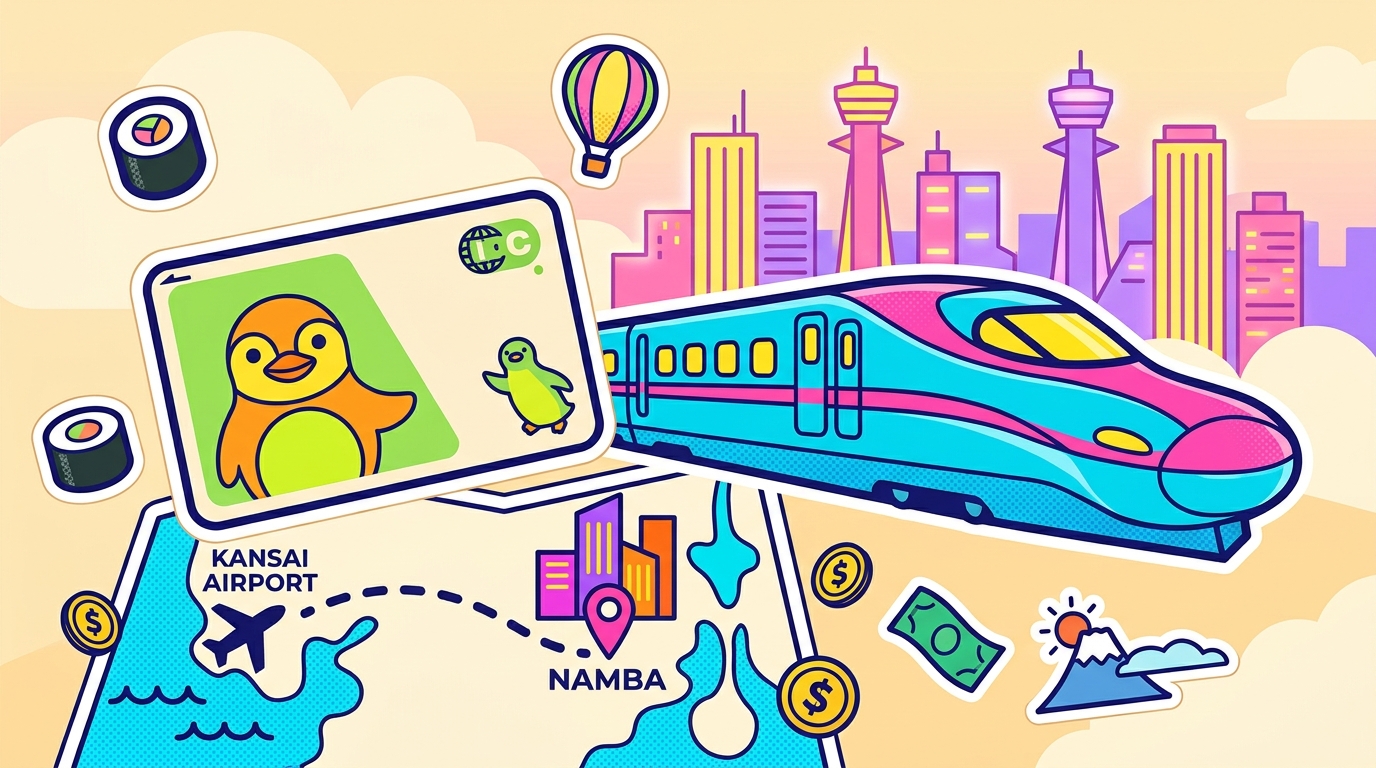
Master your arrival in Osaka with our 2026 guide to the Nankai Rapi:t Express. Learn about IC cards, fares, Super Seats, and navigating from KIX to Namba.
Getting from Kansai International Airport (KIX) into the sprawling metropolis of Osaka is the very first logistical hurdle you will face upon landing in western Japan. While there are buses, taxis, and local commuter trains, the vast majority of inbound tourists choose between two premier rail services: JR’s Haruka Express, and the Nankai Railway Limited Express "Rapi:t" (南海電鉄 特急ラピート).
If your final destination is Kyoto, Shin-Osaka, or the northern Umeda district, the JR Haruka is generally your best bet. However, if your hotel is located in the vibrant southern half of Osaka—specifically around Namba, Shinsaibashi, Dotonbori, or Nipponbashi—the Nankai Rapi:t Express is unequivocally the superior choice.
This massive, exhaustive 2026 guide will cover absolutely everything you need to know about riding the Nankai Rapi:t from Kansai Airport Station to Namba Station. From navigating the confusing world of Japanese rail fares and choosing between the Rapi:t α (alpha) and β (beta), to securing a Super Seat upgrade and navigating the sprawling labyrinth of Namba upon arrival, consider this your ultimate blueprint for a flawless arrival in Osaka.
The Great Transit Debate: Nankai Rapi:t vs. JR Haruka
Before deep-diving into the specifics of the Rapi:t, it is vital to confirm that this is actually the right train for you. Kansai International Airport is uniquely situated on an artificial island in Osaka Bay, and the railway bridge connecting it to the mainland carries tracks for two entirely separate railway companies: West Japan Railway Company (JR West) and Nankai Electric Railway.
Why Choose the Nankai Rapi:t?
The Nankai Rapi:t runs directly from Kansai Airport into Namba Station. Namba is the beating heart of "Minami" (South) Osaka. It is the entertainment, dining, and nightlife capital of the city, famous for the glowing neon of Dotonbori, the massive shopping arcades of Shinsaibashi, and the anime and gaming culture of Den Den Town.
You should take the Nankai Rapi:t if:
Your hotel is in Namba, Shinsaibashi, Nipponbashi, Dotonbori, Daikokucho, or Tennoji (via a quick transfer at Shin-Imamiya).
You want a guaranteed, reserved seat with ample luggage space.
You are transferring to the Kintetsu Railway line to head toward Nara.
You are transferring to the Hanshin Railway line to head toward Kobe or Koshien.
Why Choose the JR Haruka?
The JR Haruka completely bypasses Namba. Instead, it routes through Tennoji, heads north to Umeda (Osaka Station), continues to Shin-Osaka (the Shinkansen bullet train hub), and finishes its journey in Kyoto.
You should take the JR Haruka if:
Your final destination is Kyoto (the Haruka goes there directly; the Rapi:t would require multiple complicated transfers).
You are staying in "Kita" (North) Osaka, such as Umeda or Osaka Station.
You are holding a nationwide Japan Rail Pass or a JR West regional pass that covers the Haruka (JR passes cannot be used on the Nankai Rapi:t, as Nankai is a private, non-JR company).
You need to catch a Shinkansen immediately at Shin-Osaka Station.
Taking the Haruka when your hotel is in Namba means you will have to get off at Tennoji Station and navigate a crowded subway transfer with all your luggage. Conversely, taking the Rapi:t when your hotel is in Umeda means you will have to transfer to the Osaka Metro Midosuji Line at Namba. Choose the train that deposits you closest to your specific accommodation.
Design and Aesthetics: The Retro-Futuristic Marvel
Even if you are not a dedicated train enthusiast (a densha otaku), the Nankai Rapi:t is impossible to ignore. Among all the airport express trains in the world, the Rapi:t stands out for its incredibly bold, distinctive design.
Conceived by Japanese architect Hiroyuki Wakabayashi, the Rapi:t (officially the 50000-series) debuted on September 4, 1994, timed to coincide with the opening of Kansai Airport itself, and went on to win the Japan Railfan Club's prestigious Blue Ribbon Award in 1995. The front locomotive features a striking, retro-futuristic dark, rounded-nose design dominated by a wall of small, round portholes where a windshield would normally be. Nankai's own explanation describes the look as "a mixture of strength and speed," and Wakabayashi has said the design was actually meant to evoke a star field—the universe itself—rather than any specific character. The public, however, has read it differently for three decades: Japanese commentators often liken the robotic, helmet-like face to "Tetsujin 28-go" (the classic manga robot known abroad as Gigantor), while international fans more commonly nickname it the "Darth Vader train" for its resemblance to the Star Wars villain's mask—a comparison so widespread that Nankai itself leaned into it for an official Star Wars: The Force Awakens tie-in livery that ran on the line from November 2015 to May 2016.
While the official color is a deep, rich "lapis lazuli" blue, under the subterranean fluorescent lights of Kansai Airport Station, the locomotive often appears closer to black, reinforcing both comparisons. The sides of the train feature striking, large oval windows—a design choice meant to evoke the luxurious aesthetic of an airplane fuselage, emphasizing the transition from air travel to high-speed rail.
Best Photo Opportunities
If you want to capture a photo of this magnificent machine, do not wait until you arrive at Namba. Namba Station is a terminal station, meaning the platforms are somewhat enclosed, and the lighting can be harsh. The best place to photograph the Rapi:t is exactly where you board it: Platform 2 at Kansai Airport Station. Because it is the end of the line, the train usually idles here for 10 to 15 minutes while the cleaning crew prepares the interior. You can walk right up to the rounded nose and take unobstructed photos before boarding.
Route and Services: Rapi:t α (Alpha) vs. Rapi:t β (Beta)
When you look at the departure boards at KIX or check a digital timetable, you will notice two different variations of the train: Rapi:t α and Rapi:t β. Do not panic if you are unsure which one to take; they both go to exactly the same final destination (Namba) and they cost exactly the same amount. The only difference lies in the number of stops they make along the way.
Rapi:t α (Alpha)
The Rapi:t α is the faster, more direct variant of the service. It runs almost end-to-end with very few interruptions, prioritizing speed for airport commuters.
Availability: Historically, the Alpha service runs primarily during weekday morning rush hours and evening commuter hours, though the exact schedule shifts based on Nankai’s seasonal timetables.
Rapi:t β (Beta)
The Rapi:t β is the slightly more local variant. It stops at all the same stations as the Alpha, plus two additional stations to serve the suburban populations south of Osaka city.
Availability: The Beta is the most common variant you will encounter. If you are traveling in the middle of the day, on a weekend, or in the early afternoon, you are almost certainly boarding a Rapi:t β.
Which should you choose? Whichever one is leaving next. The time difference between the Alpha and Beta is negligible (about 4 to 5 minutes), and the fare is identical. Both variants feature the exact same train cars, seats, and luggage facilities.
Seating Classes: Regular Seat vs. Super Seat
The Nankai Rapi:t is an entirely reserved-seat train. You cannot simply board it and stand in the aisles, nor can you sit in whichever seat you please. Your ticket will assign you a specific Car Number and Seat Number.
The train is divided into two classes: the Regular Seat (Cars 1 through 4) and the premium Super Seat (Cars 5 and 6).
The Regular Seat (Standard Class)
For 90% of travelers, the Regular Seat is more than sufficient. The standard cabin is arranged in a 2-2 configuration (two seats on the left of the aisle, two on the right).
Comfort: The seats are plush, deep, and upholstered in an elegant retro pattern. They offer generous legroom—significantly more than what you likely experienced in economy class on your flight to Japan.
Amenities: The seats recline smoothly and feature drop-down tray tables suitable for a light meal or a laptop. Large oval windows provide sweeping views of the Osaka Bay coastline and the dense urban sprawl as you approach Namba.
Luggage Storage: At the ends of Cars 1 through 4, there are dedicated luggage racks for large, heavy suitcases. Because this route is actively booked by hundreds of inbound tourists daily, these racks can fill up quickly. If the racks are full, the overhead bins above the seats are surprisingly spacious and can easily accommodate airline-standard carry-on bags and backpacks.
The Super Seat (Premium Class)
Cars 5 and 6 house the "Super Seats." This is Nankai's equivalent of a First Class or Green Car experience. The cabin is arranged in a 1-2 configuration (one solitary seat on one side of the aisle, two on the other), meaning the seats are noticeably wider.
Comfort: Super Seats offer superior width, enhanced recline, deeply padded headrests, and roughly 120cm (47 inches) of seat pitch (legroom). If you are a particularly tall traveler or simply want extra space to stretch out after a brutal 14-hour flight, this cabin is incredibly comfortable.
Solo Travelers: The single-seat row is highly coveted by solo travelers who want a window view without having to sit next to a stranger.
Luggage Storage: The Super Seat cars also have dedicated end-of-car luggage racks. Because there are fewer passengers in these cars (fewer seats overall), the luggage racks here are much less likely to be completely full compared to the Regular cars.
The Cost: Upgrading to a Super Seat usually only adds a few hundred yen to your total fare—a remarkable bargain for the added comfort, especially compared to the steep premium JR charges for Green Car upgrades.
2026 Fares, Tickets, and IC Card Rules (Crucial Information)
Navigating Japanese railway fares can be incredibly confusing for first-time visitors, largely because limited express trains like the Rapi:t split their pricing into two separate components: a Base Fare (for the distance traveled) and a Limited Express Surcharge (the fee for the reserved seat and high-speed service).
The Great Fare Confusion: A Warning About Online Pricing
If you are currently researching the exact 2026 Nankai Rapi:t fare, you will undoubtedly encounter wildly conflicting numbers across different travel blogs, forums, and outdated guidebooks.
During our research for this guide, we found staggering discrepancies in published one-way fares for a Regular Seat from Kansai Airport to Namba. Some sources aggressively promote discounted combo tickets (such as the historically popular "Kanku Toku-Waa Rapi:t ticket") citing prices as low as roughly ¥1,350. Other transit aggregator sites and encyclopedias list base-plus-surcharge totals ranging anywhere from ¥1,670 up to ¥1,880. Furthermore, even official operator web pages sometimes lag behind in updating English-language PDFs following nationwide rail fare revisions.
Do not pick a random number you saw on a static blog and assume it is the definitive price.
Japanese rail networks frequently adjust their fares based on consumption tax hikes, seasonal demand, and shifting regional discount packages. Therefore, we explicitly advise you to verify the live, current price directly on the official Nankai Electric Railway website (nankai.co.jp) or by using a live, updated transit navigation app like Navitime on the exact day you intend to book.
How the Fare is Calculated
Regardless of the exact numerical cost on the day you travel, the logic of the fare remains constant. Your total ticket price is the sum of:
The Base Fare: The standard cost to travel the physical tracks from KIX to Namba.
The Limited Express Surcharge: The mandatory fee for riding the Rapi:t and securing a reserved seat.
If you upgrade to the Super Seat, the Limited Express Surcharge portion simply increases.
Can You Use an IC Card (Suica / ICOCA / Pasmo)?
This is one of the most common questions tourists ask: "Can I just tap my Suica card to ride the Rapi:t?"
If you just tap your ICOCA at the Kansai Airport ticket gates and board the Rapi:t without doing anything else, a conductor will stop you. You will be required to pay the Limited Express Surcharge in cash on the spot, and if the train is sold out, you may be asked to stand in the vestibule or disembark at the next station.
To properly ride the Rapi:t using an IC card:
Purchase a Limited Express Ticket (Tokkyu-ken) separately at the station ticket machine, at the manned counter, or via Nankai's digital ticket portal on your phone.
Tap your physical IC card (or Apple Wallet Suica) at the digital gate reader to enter the station.
Keep your separate Limited Express ticket on hand to prove your seat reservation if the conductor asks.
Advance Booking and Discount Packages
Because this route is incredibly popular—our data shows it is actively and consistently booked by thousands of tourists heading into Sennan County/Kansai Airport every single week—purchasing your ticket in advance is a massive time-saver.
If you arrive at KIX during peak afternoon hours, the queue for the manned Nankai ticket counter can stretch out the door, easily eating up 30 to 45 minutes of your vacation.
You can bypass this entirely by purchasing your Rapi:t ticket through reputable online advance-booking platforms before you even board your flight to Japan. These digital tickets often bundle the Base Fare and the Surcharge into a single QR code. Upon arrival, you simply scan your QR code at the designated ticket machines to instantly print your physical reserved seat ticket, completely skipping the massive lines at the human counter.
Timetable and Navigating Kansai Airport Station
How Frequent is the Rapi:t?
Generally speaking, the Nankai Rapi:t departs Kansai Airport roughly every 30 minutes during peak daytime and early evening hours.
The first trains usually begin running around 6:00 AM, and the final Rapi:t service of the night typically departs KIX shortly before 11:00 PM. However, much like the exact fares, you should never rely on an internet article for exact down-to-the-minute departure times. Always run a search on Google Maps or Navitime upon landing to see when the next train is leaving.
Step-by-Step: From Baggage Claim to the Platform
Navigating KIX is relatively straightforward if you know what colors to look for.
Clear Customs: After grabbing your luggage and passing through customs, you will emerge into the 1st Floor Arrivals Lobby of Terminal 1. (If you fly into Terminal 2 on a budget airline like Peach, you must first take the free shuttle bus to the Aero Plaza next to Terminal 1).
Go Up: Take the nearest elevator or escalator up to the 2nd Floor.
Cross the Bridge: Exit the terminal doors on the 2nd Floor and walk across the outdoor pedestrian bridge. This bridge leads directly into the Kansai Airport Station concourse.
Find the Orange Signs: You will see two massive banks of ticket gates side-by-side. The JR gates are on the left and are heavily branded in BLUE. The Nankai gates are on the right and are branded in bright ORANGE.
Enter the Nankai Gates: If you have an advance QR code, scan it at the Nankai ticket machines to get your physical ticket. If paying fresh, use the machines or the Nankai Ticket Office. Proceed through the orange gates.
Go Down to Platform 2: Take the escalator down one level to the platforms. The Rapi:t almost exclusively departs from Platform 2.
Arriving in Namba: The Ultimate Osaka Orientation Guide
Roughly 35 to 40 minutes after leaving the airport, the Rapi:t will pull into Nankai Namba Station.
Namba is not just a station; it is a colossal, multi-level urban complex. It actually consists of several different stations clustered together: Nankai Namba (where you are), JR Namba, Osaka Metro Namba (serving three different subway lines), and Osaka Namba (serving the Kintetsu and Hanshin railways).
To ensure you don't get hopelessly lost the moment you step off the train, here is an exhaustive guide to 8 specific, highly recommended spots in and immediately around Namba Station. We have included exact access instructions, estimated pricing, and practical operating hours to help you hit the ground running.
1. Namba Parks
If your hotel room isn't ready yet and you need a place to explore, Namba Parks is an architectural wonder located right at the station. Designed by Jon Jerde, this massive shopping complex is built to resemble a natural canyon, complete with cascading rooftop gardens that stretch across multiple city blocks.
Access: A 3-minute walk south from the central ticket gates of Nankai Namba Station. Simply walk out of the 3rd-floor central concourse, follow the pedestrian walkway south, and you will walk directly into the 2nd-floor entrance of the canyon.
Hours: Retail shops generally open 11:00 AM to 9:00 PM; restaurants open 11:00 AM to 11:00 PM.
2. Takashimaya Osaka (Namba)
Directly beneath and integrating with Nankai Namba Station is the flagship Takashimaya department store. If you are hungry after your flight, do not go to a convenience store; go to the Depachika (basement food hall) here.
What to do: Buy premium Japanese fruits, exquisite bento boxes, wagyu beef skewers, and beautifully packaged traditional sweets. It is a sensory overload of the best food in Japan.
Access: The entrance is quite literally attached to the Nankai Namba 3rd-floor ticket gates. You can take the central station escalators straight down into the basement levels.
Hours: 10:00 AM to 8:00 PM.
Price: Bentos range from ¥1,000 to ¥3,500 depending on the luxury of the ingredients.
3. Rikuro Ojisan no Mise (Uncle Rikuro’s Namba Main Store)
You have likely seen videos of this jiggly, perfectly stamped Japanese soufflé cheesecake on social media. The main store is a stone's throw from the station. The line moves fast, and they ring a bell every time a fresh batch comes out of the oven.
Access: A 5-minute walk from Nankai Namba Station. Exit the station via the massive North ground-floor exit (near the Takashimaya entrance), cross the major street (Nansan-dori), and enter the Ebisubashi-suji covered shopping arcade. The shop is on your left just inside the arcade.
Hours: 9:00 AM to 8:00 PM daily.
Price: Roughly ¥900 to ¥950 for an entire 18cm cheesecake.
4. Super Potato Namba Store (Den Den Town)
If your Osaka itinerary includes electronics and gaming, Den Den Town (Nipponbashi) is Osaka's answer to Akihabara. Super Potato is the holy grail for retro video game collectors, packed floor to ceiling with Famicom, Super Nintendo, and Sega Genesis titles. If you enjoyed reading about the Japanese Retro Feature Phone (Galapagos Keitai) Collector Guide 2026 | Where to Buy Used Gara-kei in Akihabara, you will appreciate the meticulous preservation of tech history here.
Access: A 10-minute walk southeast from Nankai Namba Station. Exit the station’s south wing, walk east until you hit Sakaisuji Avenue, and walk south. Look for the massive yellow Pac-Man and Mario signs.
Hours: 11:00 AM to 8:00 PM.
Price: Browsing is free; games range from ¥500 for common junk-bin titles to ¥50,000+ for boxed rarities.
5. Surugaya Osaka Nippombashi Main Store
Just down the street from Super Potato is Surugaya, a massive retailer specializing in second-hand anime merchandise, trading cards, and figurines. If you want to dive deep into otaku culture without taking the Shinkansen to Tokyo, this is where you start.
Access: An 11-minute walk southeast from Nankai Namba Station, located on Sakaisuji Avenue in Den Den Town, right next to the Animate building.
Hours: 11:00 AM to 9:30 PM.
Dining tip: If you spend all afternoon shopping here and get hungry, remember that Osaka's food scene rivals anything you'd find up north. Check out our Best Restaurants in Akihabara 2026 | Must-Try After Anime Shopping for an idea of the types of themed cafes and quick ramen shops that also populate Den Den Town.
6. Hozenji Yokocho & Hozenji Temple
Escape the neon madness of Namba by stepping into this narrow, stone-paved alleyway. It feels like slipping back in time to the Edo period. At the center is Hozenji Temple, featuring a statue of Fudo Myoo that is completely covered in a thick carpet of green moss due to centuries of worshippers splashing water on it for good luck.
Access: An 8-minute walk north from Nankai Namba Station. Head up the Midosuji avenue, turn right just past the Namba Marui building, and wind your way into the alleys behind Dotonbori.
Hours: The temple is open 24/7. The surrounding restaurants usually open for dinner around 5:00 PM.
Price: Free to visit the temple; a ¥100 coin donation is customary when praying.
7. Kushikatsu Daruma (Dotonbori Store)
You cannot arrive in Minami Osaka without eating Kushikatsu (deep-fried meat and vegetables on skewers). Daruma is the most famous chain, identifiable by the giant angry chef statue outside.
Access: A 12-minute walk north from Nankai Namba Station, right on the main Dotonbori canal strip near the famous Glico Running Man sign.
Hours: 11:00 AM to 10:30 PM.
Price: Skewers start around ¥150 each. Budget about ¥2,000 to ¥3,000 per person for a full meal with a beer.
Dietary Note: Kushikatsu is heavily reliant on egg and wheat batters. If you have dietary restrictions, traveling in Japan can be tricky. We highly recommend reviewing our Allergy Travel Japan | Nut Egg Dairy Free Dining with Translation Cards guide to help you navigate menus in heavily battered food districts like Dotonbori safely.
8. Rinku Premium Outlets (Bonus Stop!)
While this isn't in Namba, it is a crucial location to know about because it is located at Rinku Town Station—the very first stop the Nankai Rapi:t makes after leaving Kansai Airport! If you have a late departure flight on your last day, you can check out of your hotel, take the Rapi:t from Namba to Rinku Town, lock your luggage in the station lockers, and do some massive discounted shopping before crossing the bridge to the airport.
Access: A 6-minute walk from Rinku Town Station (accessible via the Rapi:t). Follow the elevated pedestrian walkways directly from the station to the outlet mall.
Hours: 10:00 AM to 8:00 PM.
Price: Varies wildly by brand, but discounts of 20% to 60% off premium labels (Nike, Coach, Adidas, Japanese brands) are standard.
Final Practical Tips for Your Rapi:t Journey
As you finalize your Osaka arrival plans, keep a few logistical realities in mind.
First, when you finally arrive at your hotel in the Namba area, you might be parched from a long day of travel. Before you spend ¥150 on bottled water every time you are thirsty, read up on local water safety in our Can You Drink Tap Water in Japan? | City by City Guide 2026. Osaka's municipal water is heavily purified and perfectly safe, which can save you a surprising amount of money over a two-week trip.
Second, if you are attempting to coordinate your Osaka hotel with a later leg of your trip in Tokyo, understand that Namba is a massive transit hub similar to Akihabara. If you prefer the bustling, tech-and-anime-heavy vibe of Namba, you might want to look into the Best Hotels Near Akihabara 2026 | Value Location Convenience for your Tokyo stay, as the neighborhoods share a very similar chaotic, exciting energy.
Riding the Nankai Rapi:t Express is more than just a commute; it is an initiation into the uniquely retro, slightly eccentric, and wildly efficient culture of Osaka. By understanding the fare structure, knowing exactly how to navigate Kansai Airport Station, and planning your first steps in Namba, you can bypass the stress of arrival and immediately begin enjoying one of the greatest food and entertainment cities on earth.
FAQ
Q: Can I use an IC card like Suica or ICOCA to ride the Nankai Rapi:t?
Yes, but an IC card only covers the Base Fare. You must still purchase a separate Limited Express Surcharge ticket at a machine or online for your reserved seat before boarding.
Q: What is the difference between the Rapi:t Alpha and Rapi:t Beta?
The Rapi:t Alpha is a faster service with fewer stops running mostly during rush hours. The Beta is more common and makes two extra suburban stops. Both cost the exact same and end at Namba Station.
Q: Should I take the Nankai Rapi:t or the JR Haruka from Kansai Airport?
Take the Nankai Rapi:t if your accommodation is in southern Osaka districts like Namba, Shinsaibashi, or Dotonbori. Take the JR Haruka if you are heading directly to Kyoto, Umeda, or if you are using a JR Pass.
Q: Is the Super Seat upgrade on the Nankai Rapi:t worth it?
Yes, upgrading to the Super Seat usually only adds a few hundred yen to your fare. It provides significantly wider seats in a 1-2 configuration, deeper recline, and less crowded luggage racks.
Q: Where is the best place to take a photo of the Nankai Rapi:t train?
The best location for photos is Platform 2 at Kansai Airport Station. Because it is the start of the line, the train usually idles for 10 to 15 minutes, allowing for clear, unobstructed pictures.