[PR] This article contains affiliate links.
The One Piece Card Game (OPTCG) has exploded from a niche hobby into a global juggernaut, completely transforming the trading card game landscape since its launch in 2022. For inbound tourists visiting Japan in 2026, hunting for One Piece cards in the country of their origin is nothing short of a modern pilgrimage. The lure of pristine Japanese print quality, exclusive promotional cards, and the thrill of digging through secondary market showcases in Akihabara, Nakano, and Machida draws thousands of collectors every month.
However, the Japanese market operates very differently from the West. From complex rarity distributions like the elusive "Manga Rares" and Alternate Arts (known as "Parallels" in Japan), to the incredibly strict condition grading systems used by Japanese card shops, buying One Piece cards in Tokyo or Osaka requires specialized knowledge. Add in the reality of fluctuating yen valuations and regional stock shortages, and going in blind is a recipe for overpaying or missing out on the best deals.
This massive, exhaustive guide is designed specifically for inbound tourists and international collectors looking to conquer the Japanese One Piece Card Game market. We will break down the exact mathematical pull rates of Japanese booster boxes, explain the history and current secondary market prices of every major Manga Rare, and provide an insider’s map to the best card shops in and around Tokyo—complete with Google Maps locations, exact train access, and deep-cut store recommendations far beyond the usual tourist traps.
Grab your deck box, charge your best IC card for tourists, and let’s set sail into the grand line of the Japanese One Piece Card Game market.
1. Demystifying the One Piece Card Game Rarity System
Before you step foot into a Japanese card shop, you need to speak the language of the game's rarity system. Japanese showcases are meticulously organized by rarity, set number, and color. If you don't know the difference between an SR and an SEC, or a standard card and a Parallel, you will quickly become overwhelmed by the sheer volume of cardboard on display.
The Base Rarities
The standard, non-holographic or lightly holographic cards form the backbone of any booster pack. In Japanese stores, these are often thrown into "bulk bins" (storage boxes) where you can dig through them for as little as 30 to 50 yen per card.
- Leader (L): The core card of any deck. Standard leaders feature basic anime or original artwork.
- Common (C): The most abundant cards. They lack holographic foil.
- Uncommon (UC): Slightly harder to pull than commons, but functionally bulk. No foil.
- Rare (R): The lowest tier of holographic cards. In Japanese packs, Rares feature a flat foil pattern.
The High-End Standard Rarities
These cards are stored in the glass showcases at Japanese card shops.
- Super Rare (SR): The primary hits of a standard box. These feature beautiful textured holofoil. A standard Japanese booster box contains 3 to 4 standard SRs. Prices in Japan for playable SRs usually range from 300 JPY to 2,500 JPY depending on the meta.
- Secret Rare (SEC): The crown jewels of a standard set's base run. There are usually two different SEC cards per set. They feature elaborate, highly textured foil patterns and intricate artwork. Standard SECs generally cost between 1,000 JPY and 4,000 JPY.
The Chase: Parallels (Alternate Arts)
In the West, these are commonly referred to as "Alt Arts" (AA). In Japan, they are exclusively known and labeled as Parallel (パラレル) cards. A Parallel is a functionally identical card to a base C, UC, R, SR, SEC, or Leader, but it features completely different, full-art illustrations.
- Parallel Leaders: These feature extreme close-up artwork of the character's face with aggressive, stylized texturing. Highly sought after by players who want to "bling out" their decks.
- Parallel SRs/SECs: These replace the standard artwork with dynamic, full-card illustrations, often drawn by famous guest artists from the anime industry.
Special Rarities
As the game evolved, Bandai introduced unique rarity classifications to keep sets exciting.
- Special (SP): Introduced in later sets (starting heavily around OP-03), these are reprints of highly playable cards from older sets featuring brand new, highly stylized artwork (such as wanted posters, stained glass motifs, or monochromatic thematic designs).
- Treasure Rare (TR): Specific to sets like OP-05 (Awakening of the New Era), these feature unique holographic treatments of iconic cards.
- Signature Rares (Oda Signed): The holy grail for many, featuring a gold hot-stamped facsimile signature of One Piece creator Eiichiro Oda over iconic artwork, such as the OP-05 Monkey.D.Luffy.
2. The Legendary "Manga Rares": History & 2026 Yen Prices
The absolute pinnacle of the One Piece Card Game collecting experience is the Manga Rare. Officially classified as a "Manga Alternate Art" of either a Secret Rare (SEC) or Super Rare (SR), these cards are visual masterpieces.
While we will not depict the copyrighted art here, the design philosophy of a Manga Rare is instantly recognizable: the primary character is illustrated in full, vibrant color in the foreground, while the entire background of the card is composed of a collage of actual, iconic black-and-white manga panels from the source material related to that character's lore. The foil treatment features a starburst texture that makes the color character pop incredibly hard against the monochromatic manga background.
For inbound tourists, buying a Manga Rare raw (ungraded) or in a PSA 10 slab is a primary goal. Because the yen is currently highly favorable to foreign currencies (like the USD, EUR, and GBP), purchasing these high-end cards in Tokyo can save you hundreds of dollars compared to buying them on Western auction sites.
Here is a breakdown of the major Manga Rares, their set origins, and realistic 2026 secondary market estimates in Japanese Yen (JPY) for Near Mint (NM) raw copies in Akihabara. (Note: Prices fluctuate wildly based on tournament metas, PSA grading trends, and shop inventory. These are benchmark estimates).
Shanks (OP-01 Romance Dawn)
The one that started it all. The Manga Shanks features the red-haired emperor drawing his sword against a backdrop of iconic scenes from the very first chapters of the story. Because OP-01 was vastly underprinted upon release, pristine Japanese copies of Manga Shanks carry an immense premium.
- Estimated 2026 Raw NM Price: 150,000 JPY - 180,000 JPY
- PSA 10 Estimate: 220,000 JPY+
Portgas.D.Ace (OP-02 Paramount War)
A heart-wrenching card featuring Luffy's sworn brother enveloped in his Flame-Flame fruit powers. The background manga panels chronicle his journey and ultimate sacrifice at Marineford.
- Estimated 2026 Raw NM Price: 90,000 JPY - 110,000 JPY
Sogeking (OP-03 Pillars of Strength)
A slightly more niche Manga Rare compared to the Yonko, featuring Usopp's sniper alter-ego. Because Sogeking is a slightly less "hyped" character than Shanks or Ace, this remains one of the most affordable Manga Rares for collectors looking to enter the market.
- Estimated 2026 Raw NM Price: 45,000 JPY - 60,000 JPY
Sabo (OP-04 Kingdoms of Intrigue)
Completing the ASL (Ace, Sabo, Luffy) brotherly trio, Sabo’s Manga Rare shows him wielding his pipe and fire powers, surrounded by panels of his revolutionary army exploits and childhood flashbacks in the Goa Kingdom.
- Estimated 2026 Raw NM Price: 70,000 JPY - 90,000 JPY
Monkey.D.Luffy (OP-05 Awakening of the New Era)
Arguably the most important set in the game's history, OP-05 celebrated the game's 1st anniversary and featured a Manga Rare of Luffy in his highly anticipated Gear 5 transformation. The artwork shows him laughing hysterically against a backdrop of the climax of the Wano arc. This card caused absolute pandemonium in Japanese card shops upon release.
- Estimated 2026 Raw NM Price: 250,000 JPY - 300,000 JPY (A true chase card)
Roronoa Zoro (OP-06 Wings of the Captain)
The right-hand man of the Straw Hat Pirates finally received his Manga Rare in OP-06. The art features Zoro launching a powerful flying slash, surrounded by panels of his greatest duels, from Mihawk to King.
- Estimated 2026 Raw NM Price: 110,000 JPY - 130,000 JPY
Boa Hancock (OP-07 500 Years in the Future)
The Pirate Empress and user of the Mero Mero no Mi features stunning, elegant artwork. Because "waifu tax" (the premium collectors pay for popular female characters) is incredibly strong in the Japanese TCG market, her price remains extremely robust.
- Estimated 2026 Raw NM Price: 120,000 JPY - 140,000 JPY
Silvers Rayleigh (OP-08 Two Legends)
The Dark King's Manga Rare captures his imposing presence, with background panels detailing his time mentoring Luffy on Rusukaina and his legendary clashes with the Marines.
- Estimated 2026 Raw NM Price: 80,000 JPY - 100,000 JPY
3. Japanese vs. English Pull Rates: What You Need to Know
If you are a tourist coming from North America, Europe, or Australia, you are likely used to the English format of the One Piece Card Game. Do not assume Japanese boxes work the same way. The configuration, pack contents, and mathematical pull rates are entirely different, and understanding this is vital before you spend money on sealed product in Japan.
Box Configuration Differences
- English Booster Box: 24 packs per box, 12 cards per pack.
- Japanese Booster Box: 24 packs per box, 6 cards per pack.
Because Japanese packs only contain 6 cards, they retail for significantly less (typically 220 JPY per pack at retail, or around 5,280 JPY for a sealed box at MSRP). However, due to secondary market demand, buying a sealed, untampered box of a popular set like OP-01 or OP-05 from a card shop in Akihabara might cost you anywhere from 8,000 JPY to 15,000 JPY.
The "Mapped" Japanese Pull Rates
Japanese One Piece booster boxes are collated and seeded with extreme mathematical precision. Bandai maps the boxes so that buyers are guaranteed a specific "floor" of hits.
In a standard Japanese 24-pack Booster Box, you are guaranteed to pull:
- 3 to 4 Standard SRs (Super Rares)
- 1 DON!! Card (Special foil version)
But what about the big hits (SECs and Parallels)? A Japanese box will fall into one of several predefined "Hit Configurations." When opening a box, you will get exactly one of the following combinations of big hits:
- 1 SEC (Standard) + 1 Parallel (SR, Character, or Leader) (Most common box)
- 1 SEC (Standard) + 1 SEC (Parallel)
- 2 Parallels (Usually 1 SR Parallel + 1 Leader Parallel)
- 1 SEC (Standard) + 1 Parallel + 1 SP (Special) or TR (Treasure Rare)
The "Dead Box" Warning: Because the pull rates are guaranteed, if you buy loose, unsealed packs from a sketchy storefront or an unauthorized reseller, you run the risk of buying "dead packs." If a seller opens a box, opens packs until they hit the guaranteed SEC and Parallel, the remaining packs in that box physically cannot contain anything better than a standard SR. Tourists should never buy loose Japanese One Piece packs from unregulated street vendors or random flea markets. Stick to sealed boxes or buy singles.
The Odds of Pulling a Manga Rare
Manga Rares are not guaranteed in a standard case (a case contains 12 booster boxes). While Bandai does not publish the exact official mathematical odds, extensive community crowd-sourcing in Japan has determined that the pull rate for a Manga Rare is approximately 1 in every 4 to 1 in every 6 master cases.
This means you would need to open between 48 and 72 booster boxes (1,152 to 1,728 packs) to statistically guarantee hitting one Manga Rare. This extreme scarcity is precisely why a piece of cardboard can cost upwards of 200,000 JPY.
4. The Ultimate 2026 Tokyo/Kanto Card Shop Guide for Tourists
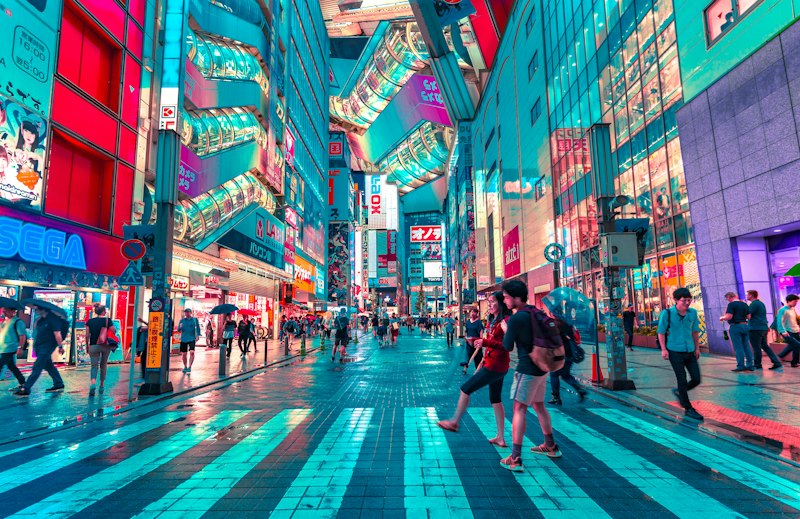
Akihabara is the undisputed mecca of the TCG world, but it is also the most heavily trafficked by tourists, meaning the best cards get bought out quickly, and prices can sometimes carry a "tourist premium." To be a savvy collector, you need to know which stores in Akihabara offer the best tax-free deals, and which suburban spots (like Machida and Hachioji) you should travel to for massive discounts.
If you are looking for general TCG advice, our 10 Best Akihabara Pokémon Card Shops (Cheapest in 2026) guide provides overlapping insights, as almost all major Pokémon shops now dedicate 30-50% of their floor space to One Piece.
Here is an exhaustive, specific list of the best places to buy One Piece cards in the greater Tokyo area, complete with transit access and maps.
1. Dragon Star (ドラゴンスター) - Akihabara Station Store
Dragon Star is one of the premier chains in Japan for One Piece. They have multiple locations in Akihabara, but the one directly next to the station is arguably the most convenient for tourists. They are renowned for their massive, blindingly bright glass showcases organized flawlessly by set and color.
- Why go here: They offer Tax-Free shopping for tourists (must show physical passport with tourist visa stamp, spend over 5,000 JPY). Their inventory of high-end Parallels and Manga Rares is usually top-tier.
- Pricing: Market average. You won't find insane hidden bargains, but you will find exactly what you want in pristine condition.
- Access: 1-minute walk from JR Akihabara Station (Electric Town Exit).
- Hours: 11:00 AM - 8:00 PM (Weekdays), 10:00 AM - 8:00 PM (Weekends).
2. Card Rush (カードラッシュ) - Akihabara Stores 1 & 2
Card Rush is famous among Japanese players for having some of the lowest base prices for singles in the city. The catch? They generally do not offer tax-free shopping, and the store aisles are incredibly narrow.
- Why go here: If you are building a playing deck rather than looking for a graded Manga Rare, Card Rush is king. You can buy meta-relevant SRs and standard SECs via their touch-screen tablet system. You browse the inventory on a mounted iPad, add cards to your cart, print a receipt, and take it to the counter. The staff fetches the cards from the back.
- Pricing: Extremely competitive, often 10-15% cheaper than stores with glass showcases.
- Access: 3-minute walk from JR Akihabara Station down Chuo-dori street.
- Hours: 1:00 PM - 9:00 PM (Weekdays), 11:00 AM - 9:00 PM (Weekends).
3. Bookoff Super Bazaar - Hachioji Minamino
Want to escape the tourist traps? Take a 50-minute train ride out of central Tokyo to the suburbs. Bookoff is Japan's largest used goods chain, but their "Super Bazaar" locations feature massive, dedicated Trading Card spaces.
- Why go here: The "Junk Bins" (ストレージ - Storage). Bookoff has rows upon rows of unsorted 30-yen and 50-yen boxes. While you won't find a Manga Rare in there, you can spend hours digging to find valuable foil Rares, standard SRs, and promo cards that were mistakenly tossed in by staff. Furthermore, their glass showcase prices for Parallels are often priced based on an older internal corporate system, meaning you can sometimes find highly sought-after OP-02 or OP-03 cards for thousands of yen cheaper than in Akihabara.
- Pricing: Cheap, with potential for massive hidden bargains.
- Access: Take the JR Chuo Line from Shinjuku to Hachioji, transfer to the Yokohama Line to Hachioji-Minamino Station. 3-minute walk from the station.
- Hours: 10:00 AM - 9:00 PM.
4. Hobby Off - Machida Central Store
Machida is a bustling commercial hub located in southern Tokyo, often referred to as the "Akihabara of the West" by locals because of its dense concentration of anime, gaming, and card shops.
- Why go here: Hobby Off (part of the Hard Off group) focuses strictly on toys and collectibles. The Machida location has an expansive One Piece section. Because it is highly frequented by local suburban players rather than international tourists with deep pockets, the turnover of mid-tier Parallel cards is very high, and the condition grading is strict, meaning a heavily discounted "B-Rank" card is often practically flawless.
- Access: 35 minutes via the Odakyu Odawara Line (Rapid Express) from Shinjuku Station. The store is a 5-minute walk from Machida Station's North Exit.
- Hours: 10:30 AM - 8:00 PM.
5. magipoke (magi) - Nakano Broadway
Nakano Broadway is famous as a vintage anime and watch collector's paradise, but in recent years, high-end card shops have moved in. "magi" is an app-based company (similar to Mercari for cards) that opened physical storefronts.
- Why go here: If you want PSA 10 slabs of Manga Rares, Oda Signed cards, and ultra-rare tournament prize cards (like the Serialized Shanks or Luffy), magi is the place. It feels like an art gallery or a high-end jewelry store.
- Pricing: Premium. This is not the place for bulk. This is where you drop 300,000 JPY on a slabbed museum piece.
- Access: 5-minute walk through the Sun Mall shopping arcade from Nakano Station (JR Chuo Line, 5 minutes from Shinjuku). Located on the 2nd floor of Nakano Broadway.
- Hours: 1:00 PM - 6:00 PM (Hours are notoriously short, always double-check).
6. Bee Honpo (Bee本舗) - Ikebukuro
Ikebukuro is Tokyo's second-biggest otaku hub, generally known for female-oriented media, but it boasts incredible card shops. Bee Honpo is a fan-favorite.
- Why go here: The aesthetic and the Oripa (more on this later). The store is beautifully designed, heavily leaning into pirate and fantasy themes perfectly fitting for One Piece. Their showcases are massive, and their staff is known to be slightly more patient with non-Japanese speakers.
- Access: 5-minute walk from JR Ikebukuro Station (East Exit).
- Hours: 12:00 PM - 8:00 PM.
5. Navigating Japanese Card Shops: A Tourist's Guide to Buying Singles
Walking into a Japanese card shop can be intimidating. You cannot just open the glass doors and grab the 100,000 JPY Manga Zoro. There is a specific, polite protocol you must follow.
The Condition Grading System (Crucial for Tourists)
Japanese card collectors are notoriously the strictest in the world regarding card condition. A card that an American would happily call "Near Mint (NM)" will often be labeled as lightly played or damaged in Japan. This works massively in your favor.
When looking at price tags in showcases, look for letters or stickers indicating condition:
- S or No Letter: Near Mint/Mint. Flawless.
- A (Aランク): Excellent. Might have microscopic corner whitening only visible under harsh light.
- B (Bランク) or Kizu (キズ / 傷): Lightly Played. This means there is a scratch (kizu), slight edge wear, or print lines. Tourist Hack: Always ask to look at the B-rank / Kizu cards. They are usually discounted by 20% to 40%, and to the naked eye of 99% of collectors, they look absolutely perfect in a binder.
- C (Cランク): Played. Visible creases or heavy edge wear.
How to Ask a Staff Member to Open a Showcase
When you see a card you want, stand by the case and locate a roving staff member.
- Raise your hand slightly and say: "Sumimasen!" (Excuse me).
- Point to the glass and say: "Kesu o akete kudasai." (Please open the case).
- The staff will come over with a small tray. Point to the card you want. Do not try to reach into the case yourself; this is considered incredibly rude and a security risk. The staff will take the card out and place it on the tray.
- If you want to inspect the condition, say: "Joutai o kakunin shite mo ii desu ka?" (Can I check the condition?). They will nod. Rule of thumb: Do not take the card out of its protective plastic sleeve. Hold it by the edges, tilt it against the ceiling light to look for scratches, and hand it back.
- If you want to buy it, say: "Kore o onegaishimasu." (This one, please). They will keep it behind the register under a number tag. They will give you a clipboard with a number. When you are done shopping, take the number to the register to pay.
Payment and Tax-Free Shopping
While Japan is slowly modernizing, many smaller card shops still prefer cash, especially for large transactions. Before you drop 150,000 JPY on a Manga Rare, review our guide on Cash vs Card in Japan 2026: How Much Cash Do You Need?. If you are shopping at a major chain like Dragon Star, they will accept Visa/Mastercard.
To claim your 10% Tax-Free exemption:
- You must have your physical passport with you. (Copies or photos on your phone will be rejected).
- Your passport must have a temporary visitor entry sticker/stamp (not a student or work visa).
- Your total purchase at that specific store must exceed 5,000 JPY (before tax).